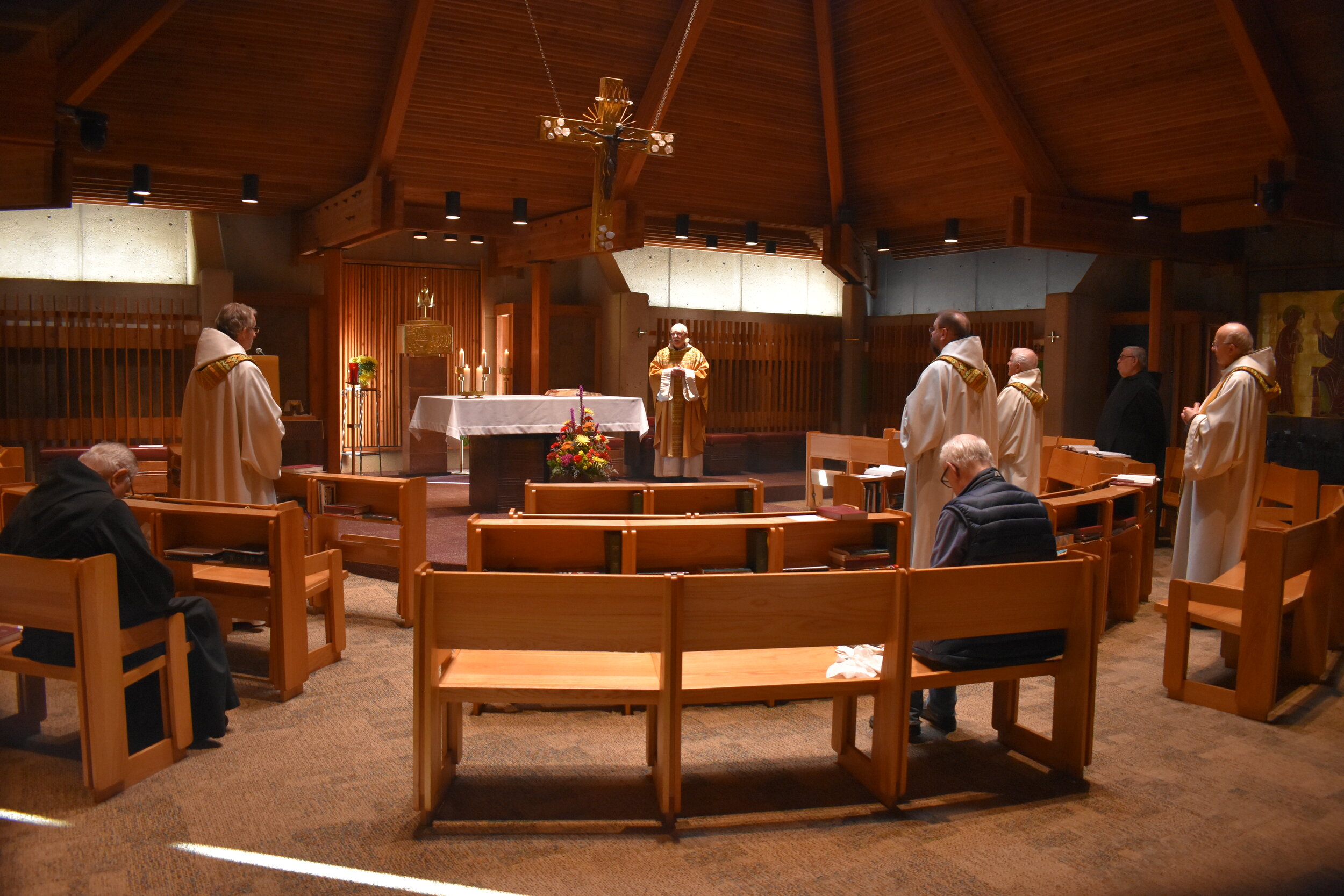
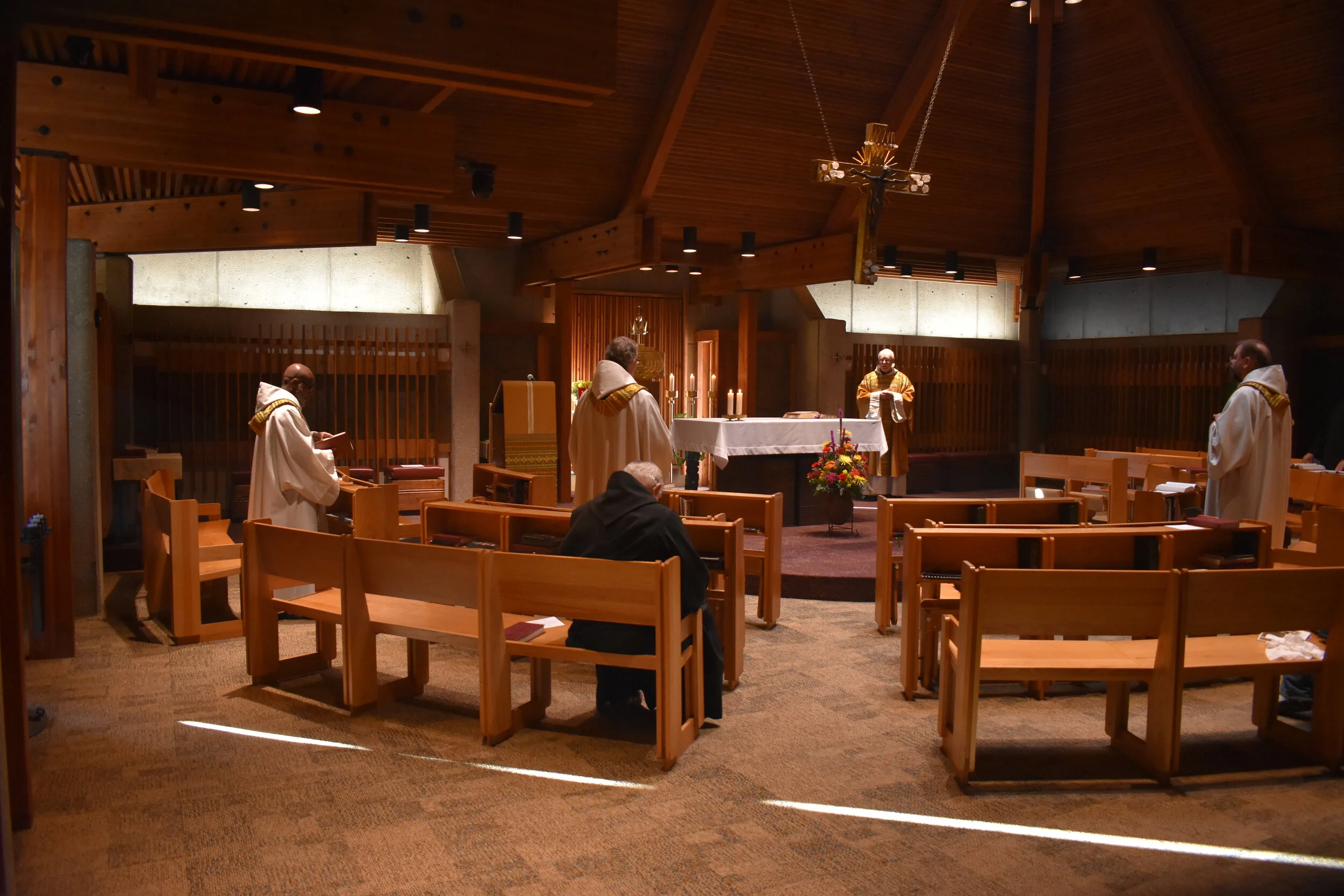
Due to technical issues we were not able to Live Stream the special prayers and Compline on New Year’s Eve. Below is the text of the message from Fr. Joel Macul, our Prior.
New Year’s Eve 2020
Genesis 1:14–18
Thanksgiving for the Year
We sometimes forget that the first thing created was time. Time was created on day one of our Judeo-Christian creation tradition by creating light. Then this light in the midst of darkness was used to demarcate day one, day two and so forth. After day one, it is day four that makes it clear that the creation of light marks out time into days and seasons. It colorfully does this by specifying the light of day and the lights of night. No matter how we divide up the passage from night to day we have to say that it is all good: days are good, seasons and times are good. So when we come to this particular unit of time called 2020 we have to hear the poetic phrase: “And God saw that it was good.”
Some may find it a bit difficult to verbalize that after the year 2020. Many will be heard to say, “Thank God its over,” or “There’ll be nothing like it” and think “Good riddance” because it is hard to see any good in it. But when we come together for a few moments at the end of this year 2020 and pause to give praise to God and give thanks, we are resisting the temptation to push this unit of time away. If our tradition says that time comes from God, and we say that it came into being through Christ like all created reality, then we cannot simple shake the dust of the past months off our feet and go on. We must also stand firm in another part of our tradition that says, give thanks always for God’s great love is without end. And so we come together at the end of this year to count blessings and to give thanks. This too is part of our resistance to simply wipe off the year. We must stand with it and in it and give thanks.
Each of us will have our own litany of thanks this year. It will have the lens of the pandemic about it but then we Christians are not strangers to suffering. We are not strangers in finding that love works at the heart of pain and suffering. Our God does marvelous things with what we might call lost and over the edge. There will be the tendency for some of us to read the time passed through the pandemic and its consequences alone. But we must see the time of this year with all the vision that the Gospel give us, with the light of Christ whom we are celebrating these days as come into the world.
Surely the pandemic is asking humanity to look again at itself. It stripped away, for some, what we thought was so essential. Maybe so we could find again what is it that is essential for being human. The year has been an invitation for us to confess a solidarity beyond ourselves and accept the link we have with others. As we pause to look back over our lives, we will need to give thanks for what we think we lost but also for what we found. Perhaps it will come in terms of thinking of others first, of listening to the stories of those who have less of this worlds goods and privileges than we do; perhaps in simply slowing down and seeing and hearing better for it. Perhaps in finding new ways to stay in touch. It is important to give thanks and praise not just for what we experienced despite the hard times but because of the sudden shift of what is/was normal. What was revealed this year may have been forgotten or even unknown but now has enriched our lives.
Pope Francis has taken up the 150th anniversary of naming St. Joseph, Mary’s husband, as patron of the Church and declared a Year of St. Joseph. This may help us as we transition from one cycle of time into another. One can say two things that are characteristic about Joseph as presented in the Gospels:
The first is that he is a person who cares. He cares for his wife and the Child Jesus. Time and again he has to move. So he picks up the child and takes Mary to the next stage. A person who cares. And in this caring he is looking after the vulnerable, a young wife and her son. He is entering into crises that disrupt his small family’s life at its very beginning. Caring. That is what we are also to be about as we move on. Caring, caring for one another, putting the interests of others first as St. Benedict reminds us, looking after the vulnerable; caring that translates into sharing. There is also caring for where we live, for the environment of the earth; and caring for the cultures of the peoples on the earth. Caring, that is how “and God saw that it was good” is played out today.
The second theme connected with Joseph: He never speaks. He is, as is classically put, the silent one. This is not negative. Rather it means that he listens and then acts. It is a reminder to us that we might just need less comment and commentary, less judgmental statements, and less talking to myself. For the silence of Joseph is a silence born out of love. His is a word that speaks volumes because there is no wasted word. To walk alongside others in a silence that understands and cares….maybe that is what the coming year needs from you and me.
Now let us take a few moments of silence so that Thanksgiving for the Grace that has appeared this past year may be named in the quiet of our hearts.
~ Prior, Fr. Joel Macul