

Fr. Adam Patras, OSB - celebrant

22nd Sunday in Ordinary Time - 2021
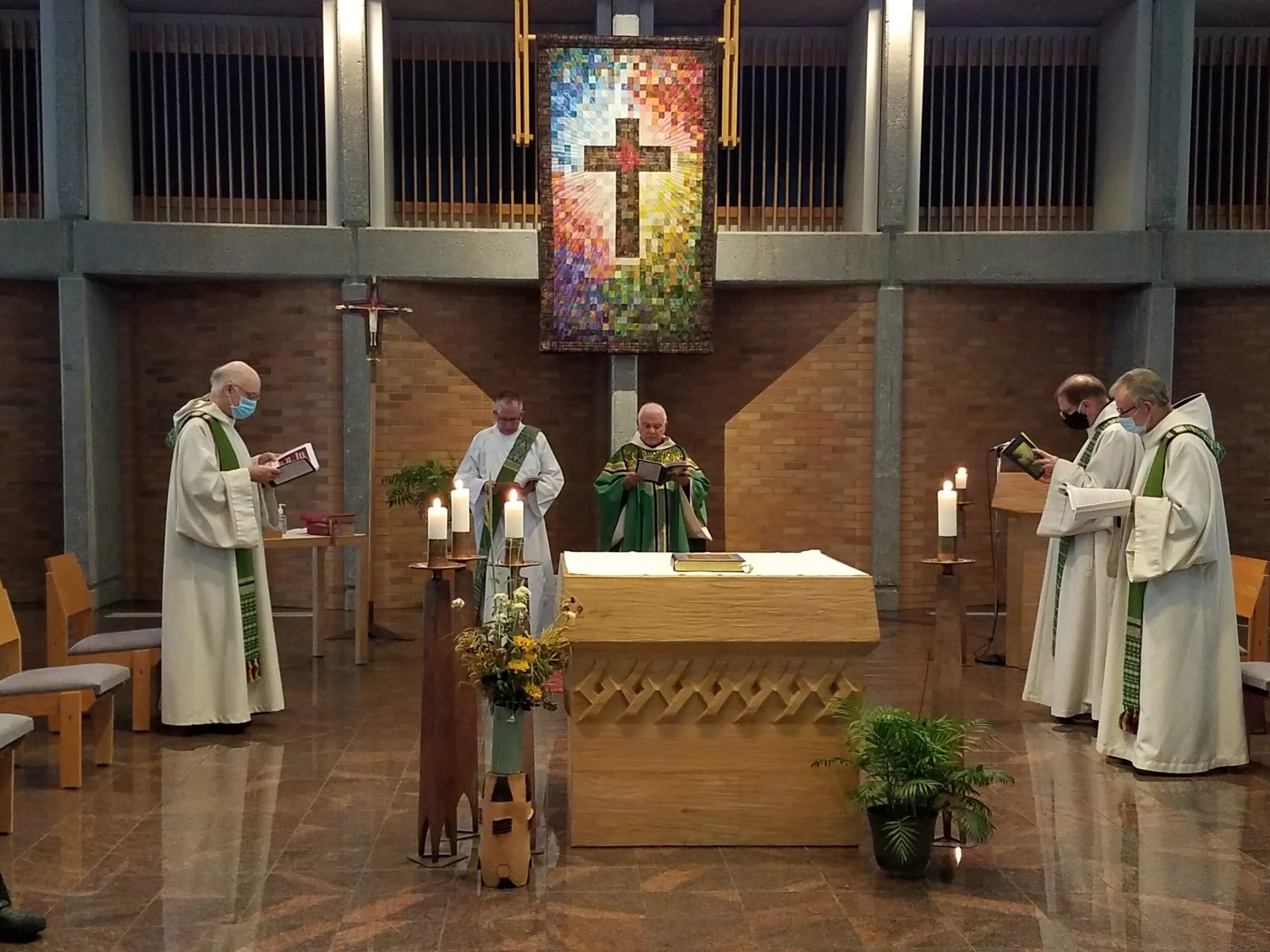
Fr. Thomas Hillenbrand, OSB was the celebrant this morning. He was assisted by Deacon David Brown from Boone, IA and music ministry provided by Sr,. Denette Leifeld, OSB, Sacred Heart Monastery, Yankton.


Thursday of the 21st week in Ordinary Time
Prior Fr. Joel’s Homily:
1 Thessalonians 3:7–13
Matthew 24:42–51
In our weekday reading of Matthew’s Gospel, we suddenly find ourselves confronted with something of the Advent theme. We find we are standing in front of the reality that Jesus is coming again. We also find that it is one case where we need to be an agnostic. We simply do not know when this coming of the Master and Lord will be. And guessing is not the way to approach this situation.
We need to be honest and admit that the coming of Jesus does not really impinge on our daily lives. Who of us thinks of it? We hear it mentioned in the Eucharistic prayer and in the prayer that follows the Our Father in the Eucharist. We profess it in our creed each Sunday. But saying it is one thing. Having it effect us is mostly quite distant from us.
There are two tasks in front us is response to the proclamation of the Lord’s coming. The first is watchfulness or vigilance. Stay Awake, Jesus says. These are the same words Jesus asks of his chosen disciples as he begins to pray in Gethsemane. He is preparing himself to face death and he asks the disciples to stay awake and be with him. But vigilance, watchfulness or even mindfulness is an essential element in our lives. We are not meant to drift through life. Probably even more difficult for those of us whose lives are very routine. We just fall into the routine. But vigilance means being alert, being aware of what is happening. It would mean then knowing our priorities, what is essential. Vigilance comes with making choices.
This leads to the second task Jesus puts in front of us. Yes, the master is taking a long time coming. We can verify that after 2000 years. What are we supposed to do with all this waiting time? What does our attentiveness look like. Pope Francis is very clear that the long wait easily evolves into complacency. We don’t care any more. Situations are happening around us and we don’t see them anymore, whether they are bad or good. For example, people are migrating and being displaced. Who is asking why is this happening? What is bringing this about? What does this movement ask of us?
To check our attitude Jesus puts in front of us the image of a servant, actually a slave. We might find this image of the servant repulsive. But if we stay with the image, we find out that it is really about responsibility and entrustment. We are not empty handed as we wait. We are entrusted with much to care for and look after. How are we doing with that? Waiting for the master to come is not an empty time. There is the possibility that we can abuse what we have been entrusted with. The biggest abuse can be in thinking we possess it in some exclusive way. The what we think we possess can be as big as the created world, nature and the universe. It can be as intimate as personal relationships. It can be a small as the simple things that make up my everyday life. In any case, we are challenged to how we respond. We can either possess and use up, or we can care for the gift and make sure that it is passed on for others. The good servant knows that he is responsible for what gift he or she has been given. It is always for others. The good servant’s power lies in caring and observing and then acting. The good servant is awake and listening.
Thinking about Jesus coming again is not about daydreaming when will he come. It seems that it is an opportunity to be focused on my relationship with the present. If Jesus does not seem to come, maybe it is because we have not recognized the ways he is coming. Or maybe we have not yet learned the discipline of caring and sharing what was entrusted to us. When we have learned how to care for what God has entrusted to us, then Jesus can come and gather us together and present us to his Father. Until then we are to watch for and over all that he has gifted us. Our task: being responsible for what is gift, what is grace.
~Prior, Fr. Joel Macul, OSB
21st Sunday in Ordinary Time
Below is the text of Fr. Joel’s Homily:
Joshua 24:1-2a, 15-17, 18b
Ephesians 5: 21-32
John 6:60-69
Choices and decisions. That seems to be what comes across clearly as we listen to the Word today. Joshua challenges the whole people: Choose whom you will serve. Jesus has spoken; his words are seen as hard by some. Will you stick with him despite hard words or will you leave him at this point. Choices. What kind of relationship will ground a family, a husband and wife? Apparently, the Christian needs to live in the self-sacrifice of Christ. That is the value that is the action that guides all forms of relationships, even the intimate relations between wife and husband.
Today we finish our listening to the Gospel of John where Jesus identifies himself as the Bread of Life. (This year, Jesus’ Bread of Life discourse was interrupted last Sunday so we could celebrate a resurrection feast–something of a disadvantage in hearing all of what Jesus has to say). Now, today, we are allowed to hear the response to Jesus’ words. For the first time we get to hear the disciples’ response. They, too, begin to murmur and complain. And their complaint is that this is a hard saying. Who can accept it?
We have to ask ourselves, what is the hard saying Jesus has spoken and what makes it difficult to accept. If we are familiar with what Jesus has been saying up to this point, we can hazard a guess that it has something to do with Jesus giving his own flesh and blood to eat and drink. This is very graphic language and nowhere else in the New Testament is the relationship between Jesus and his followers put so sharply. It is so sharply put that it is almost offensive. For who really wants to hear about eating somebody’s flesh and drinking somebody’s blood. Of course, if we put it in the context of the Eucharistic meal we are familiar with, then it makes some sense. And we can understand it.
Just what is hard here? Is believing that Jesus identifies himself with the simple food of bread and wine so difficult? It does set off Christians from believers from other traditions. And it also marks different grades of Christians among themselves.
What makes such a saying hard? It might have something to do with the contrast between life and death. The choice in the end is a matter of life or death. Jesus has been telling us all along that the bread that will give life is his flesh for the life of the world. What will give sustenance and life to you and I and beyond to the world itself is his own death. It is in his dying that he will become life for the world. It doesn’t make a lot of sense to most people that the death of a person will bring life to others. In general, most people don’t approach death as a source of life. Jesus hints that the food he will give will be the product of the real flesh and blood offering of himself. Just as the sacrifices of the temple involved real flesh and blood, so Jesus’ own death will involve his flesh and blood. When Jesus starts talking about death in such a new way this is disturbing. And so some followers start leaving. When the leader starts talking about dying in some generous act that will be of service to the whole world, this is something utterly new. The implications of it for us are drastic as well.
When the Gospel reports that many followers leave Js at this point, it is only reflecting what happens when Jesus actually meets his own death. The story is clear, the twelve, apparently faithful, are certainly not united at that point. One decides to make money and is paid to hand him over. The leader of the group denies Jesus and the rest pretty much run away. The prospect of Jesus dying suddenly changes the nature of people’s fidelity. Who will stick with a dying hero? If Jesus’ way of life leads to death, what might happen to you or me?
All the words we have heard from Jesus’ Bread of Life teaching have been about God’s revelation that we will find life in the midst of death. What Jesus has been talking about is a new kind of life that does not come to an end. But this new kind of life without end is only had by sharing in the very death of Jesus. To share in the flesh given for the sake of the world is to find yourself on the road to life. Remember how many times Jesus says that the bread given before did not save from death. Your ancestors ate this bread but they are dead. Eat my bread and you will live forever. Whoever feeds on me will live forever.
If we live our lives from a perspective that tries so hard to keep life and death separated, far apart from one another, then this is a hard saying of Jesus. To accept Jesus’ word means to accept that God has filled death with life. If we accept Jesus’ word then we no longer try to keep death and life apart. Instead, we are willing to believe that God can take care of us, can feed us with a death that is filled with life. The broken body of Jesus, Jesus life spilled out, is what we share in. And by sharing in it, we touch life at its deepest level.
There is no doubt that Jesus is talking about his disciples gathering to remember him in the breaking of bread and the drinking from the cup. Jesus is talking about Eucharist. He is talking about what we are about right now and each Sunday. He is offering to us again and again, the hard thing he was about—it is in dying that one lives. He is talking about the foolishness of the cross; the symbol of oppression and violent death becomes the place where God shows his wisdom, expresses his love. In the Bread and Cup which is Jesus’ life blood poured out for the sake of the world, there is a power and a spirit that does not die.
At the Eucharist, we are establishing a link with a life and power that do not end. At the Eucharist, we are setting the course and direction of our lives. It is not just a question of whether Jesus is present to us or not. He is present. But what kind of presence is he offering us? And are we willing to accept that? Are we willing to accept that God has filled this man’s death with Spirit and power and love? Are we willing to accept that a life freely given for the sake of others is the only model and pattern for our life here?
We are like the community Joshua has assembled; we are like the disciples who have followed Jesus up to this point. But now there is a choice to be made, yes and a hard one. There are options. Joshua spells them out: you can look to the past, to the good old days, where you thought it was safe (do what your ancestors did), or you can live in the present and allow the values and norms, the lords of your society and culture, like individualism, consumerism, success, self-righteousness, and my-way-is-the-only-way be what you follow, or you can reverence Christ and hand over your life in self-giving out of faithful love so that others may be cherished, set free and nourished in the Spirit.
The Eucharist is a dangerous act. It is an act of faith that God fills death with life in the shape of self-sacrificing love. It is an act of faith that says that God does this completely in Jesus, who is God’s Holy One. It is an act of faith that says: in this eating and drinking, I am making a commitment toward living forever, for in this bread and cup lie the love and freedom all humanity longs to know.
~Prior, Fr. Joel Macul, OSB
Assumption of the Blessed Virgin Mary
Lk 1:39-56
Rev 11:9, 12:1-10
1 Cor 15:20-27
Focus: One day, we, too, will be received, with our whole existence, our whole person, into the fullness of God’s glory and God’s light.
A few years ago I was invited to give a presentation to a group of United Methodist pastors (the monks may remember this story). The group asked me to speak on the Rosary, in which one of the pastors had taken a special interest! To my surprise, the talk was received well. I described the Rosary as rooted in Holy Scripture, as a way of reflecting about the most central mysteries of our Christian faith and of praying with them.
With most mysteries of the Rosary, immediately one or more Scripture passages come to mind that express them. Even the last one, the Coronation of Mary as Queen of Heaven and Earth, has a direct biblical reference, namely in today’s first reading: “A woman clothed with the sun,… on her head a [royal] crown of twelve stars.” At first sight, the exception seems to be the Assumption of Mary into Heaven with Body and Soul. Is this mystery biblical?
Today’s second reading points us into the right direction. “Christ has been raised from the dead, the first fruits of those who have fallen asleep.… For just as in Adam all die, so too, in Christ all shall be brought to life.” St. Paul is proclaiming in this Chapter 15 of his First Letter to the Corinthians
the resurrection of the body, not only the immortality of the soul.
What the Catholic Church has defined as the “Assumption of Mary into Heaven,” is simply a specific application, based on the great dignity and special role of Mary as the Mother of Jesus.
The mystery of today’s feast is a particular case of our general belief in the resurrection. It is also about that which ultimately awaits all of us! We profess in the Apostolic Creed (which is the start of the Rosary): “I believe in the resurrection of the body [as a promise for all of us] and life everlasting.”
The Feast of the Assumption of Mary into Heaven is the feast of our own hope! With Mary we celebrate one of us who has arrived already at the destination, who has been received into heaven with body and soul. We, who have been connected with Christ since our baptism, who have put on Christ in our baptism like a garment and already have a share in His Divine life, are promised to experience one day, as Mary did, the resurrection of the body, of our bodies, and immortality.
Today’s gospel is Mary’s encounter with Elizabeth. Mary helps her pregnant kinswoman; and Elizabeth recognizes the Divine mystery in her. In response, Mary praises God who looks on the lowliness of God’s servants.
We, too, have reason to praise God for the many great things that God has done already in our lives. It is good to do this on a regular basis. I do it every night in my Examination of Consciousness, which starts with thanking God and praising God for God’s gifts to me during this past day.
Dear sisters and brothers in faith, One day, we also will be received, with our whole existence, our whole person, into the fullness of God’s glory, God’s light and God’s peace.
There is another wonderful Scripture passage that shows the meaning of today’s feast. In the Song of Songs, the lover speaks to the beloved: “Arise, my love, my beautiful one, and come.” We confess today that God has said this to Mary, God, the great Lover, to the beloved. We believe that God will speak to us one day in the same way: Arise, my beloved, come!
While still here on earth, we invoke Mary for her intercession. As we pray the Rosary, as we meditate on the mysteries of our faith, each of which says something about us, too, Mary helps us to become ever more fully disciples of her son, Jesus. And we grow stronger in our hope for the destination of our own life’s journey in God, for heaven. AMEN.
~Fr Thomas Leitner, OSB


19th Sunday in Ordinary Time
Fr. Adam Patras, OSB - celebrant

Transfiguration of our Lord
Daniel 7:9–10, 13–14
2 Peter 1:16–19
Mark 9:2–10
Here in eastern Nebraska it will be difficult to find a mountain to climb and so have a mountaintop experience. Instead, you have to use your imagination. To aid our imagination we have the Scriptures where mountaintop experiences are kept alive for us. Today we are looking in, as it were, on a mountaintop experience of Jesus with his chosen disciples. We are familiar with other mountain experiences like that of Moses and Elijah, who also appear with Jesus on the mountaintop.
Mountaintops are classically understood in religious systems as being places where we are close to God. God dwells on the mountain top. In fact, an old name for Mt Sinai given by the monks who lived at its foot was “The God-trodden Mount of Sinai.” On the mountain the air is thin. It is a thin place and this world easily opens to the unseen but real world. Jesus goes mountain climbing today with three disciples. On the top Jesus is drawn into the other world and for the first time, the disciples see the other side of Jesus. They find he is one with his ancestors and in the voice from the cloud, they hear his true identity as the Father’s Son. It is on the mountaintop that Jesus identity becomes clearer: he is one with the Law, he is one with the Prophets and he is one with his Father. The disciples are given a glimpse of the relationships that support Jesus and give him his mandate while he is walking the earth.
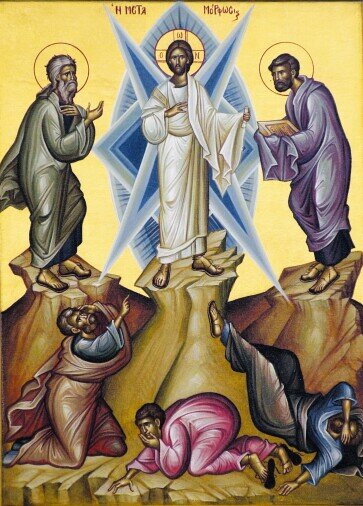
Jesus is changed in such a way that the inaccessible light of God affects him deeply, even his clothing becomes white like light. What we profess in our creed is given to us to see today: Jesus is light from light. In Jesus, the disciples for a moment have a glimpse of light come into the world. In the Byzantine icons of the transfiguration you will often see rays of light emanating from the central figure of Jesus. The light indicates the transforming process. We know that creation begins when light is placed first in the scheme of things.
The Father speaks today. And he identifies Jesus as Son. But he also speaks to us. The words are simple and uncomplicated: Listen to him. We are not brought to the mountaintop to simply gaze and Jesus and then fumble for words at seeing who he is. We are brought to the mountaintop so that we too are part of the vision, part of the change that we witness in Jesus. And how does this change or transformation come about in us? It happens in the process of listening to the Word that is Jesus.
If we wish a share in the transformation we witness on the mountain, then we desire a good thing; it can happen to us. In fact it almost seems mandated for us. The process of change, of conversion of putting on the mind of Christ will happen to the degree that we enter into the listening process. When we follow the Word that is Christ, attuned to it and remaining faithful to it, we will change. And in that process of listening we will find our true identity. Notice, in this case,it is not Jesus who gives us the direct command to listen, but God the Father. As he names Jesus his Son, so he gives us the way in which we too can enter into the relationship of being a child of God. We follow the Word.
This following takes a life time. It happens in slowly learning the art of listening and responding, first to the Word and then the way the word comes to us in various situations and people. Having an open ear is the beginning of a transformation of our hearts.
Remember that Jesus told his disciples they could not speak about what they had seen and heard until Jesus had risen. Why? Because then the process of transformation would be complete for him. He would have been a faithful Son to the end. With us also, we are in process. On the mountaintop, we had a glimpse of light transforming our inner and outer selves. We heard the command of our Father, “Listen to him.” With this vision and this word of the Father we descend the mountaintop enlightened and hopefully ready to make the journey of life together with the Father’s Son.
~Prior, Fr. Joel Macul, OSB
18th Sunday in Ordinary Time
Fr. Tom Hillenbrand, OSB - celebrant.


Memorial of St. Martha
Gospel John 11:19–27
We know of Mary and Martha from Luke’s Gospel. However, it is John who presents them along with Lazarus their brother twice. In each instance in John, all three are part of the story.
For us Benedictines, remembering these sisters and their brother and their relationship to Jesus evokes our specific service of hospitality, our tradition of welcoming guests— and specifically as welcoming them in Christ. For us they are not some biblical characters from the past. They speak to us in a concrete way about our relationships with one another, with the guest who stops by, and above all the way we relate with Jesus in those who come to us from outside.

John seems to be giving us a preview of what Jesus will later say to the disciples at the Last Supper: I no longer call you servants but my friends. Why? Because I have revealed to you all that the Father has shared with me. Mary, Martha and Lazarus are Jesus’ friends. He can be with them easily because they are brother and sister to one another. They model the church where all are brother and sister to one another. Understanding ourselves in that mode, Jesus easily sits with us. The three of them share food with Jesus, throw him a dinner before he is to begin his final act in Jerusalem. In his visits, he always brings something for them. The welcoming leads to an openness that means accepting the gift of the guest. And his last gift is that of resurrection.
Today we hear Martha speak a very moving line, a line that can only be spoken by a friend to a friend: If you had been here my brother would not have died. It may sound like a reproach but in reality it wells up from a love shared between friends. I sometimes wonder that when we as a community receive a guest we are receiving something that fills us anew. And when that guest leaves we are sad to see him or her depart. Their presence has made a difference. It would be rare for a guest to solve a community problem or heal a wound such as Martha and Mary’s loss of their brother. But still, Martha’s line points us in a direction that invites us once again to look at our service of monastic hospitality. And at the same time remembrance of the home at Bethany invites us to ask ourselves how we have been enriched by hospitality: the people that have entered our personal lives and life as a community. Welcoming Christ like Martha Mary and Lazarus is not left to some past moment in the life of Jesus. We bring it forward and receive into our midst the Christ present in people of the faith and also those not of the faith but who share in our common humanity as brothers and sisters.
Each of the three persons of Bethany offer us a dimension of our receiving of people. Martha is about service, service at the table. Eating with guests is important for Benedict as it means acceptance. Mary, on the other hand, is the one who ponders the words of the guest. She is aware that the guest is a host in his or her own way. She guides us in our lingering over the gracious Word that has been handed on to us in Scripture. And Lazarus, he reminds us that the love and life shared here has a future. It does not die. Jesus who is in our midst is the guarantee that love here is the beginning of eternal life. Lazarus is raised because Jesus loved his friends. He promises to do the same with us and for us.
~Prior, Fr. Joel Macul, OSB
17th Week in Ordinary Time
2 Kings 4:42–44
Ephesians 4:1–6
John 6:1–15
Today we interrupt our reading of Mark’s gospel on Sunday. At the point where Mark’s gospel tells a feeding story, we switch instead to chapter 6 of John’s gospel. From there we hear a feeding story. But in John, this feeding story is followed by a long discourse on the significance of the Bread. The Church wants us to hear that discourse from John’s Gospel. It is known as the Bread of Life discourse. We will hear it on the next four Sundays. Jesus the teacher will break open for us the meaning of this bread he gives out today; he will teach us and in the end will ask us if will follow him in what this Bread really means. Today we are invited to reflect on the event of the feeding itself.
The story of Jesus feeding a large crowd is the only miracle story that occurs in all four Gospels and in Mark and Matthew, the story is told twice, each time with a significant focus. For us Christians centuries later, it is clear that the story about the Bread is related to the Eucharist; it was the same for the early Church, a precious memory that deserved to be recounted a number of times. It is also clear that such bread stories can be found in the Old Testament such as we have heard today in the story about the prophet Elisha. Indeed, the Bread stories in the Hebrew Bible are one of the sources for our Eucharistic celebrations today. Bread is of significance far beyond what appears on the surface, satisfying human hunger. So our Eucharist extends far beyond what our eyes may at first see.
We find Jesus going up on the mountain, traditionally a place close to God. We hear that he sat down. In the biblical tradition the teacher sits. The crowd follows but we hear they follow because Jesus works signs of healing. Perhaps they are looking for more marvels. They are hungry for something Jesus has, but they really are not sure of what that hunger is. But Jesus is very much aware. Jesus draws us into the story by asking where can we buy enough to feed them? Jesus looks out and sees the physical situation. He presents it to us. How can we respond to this hunger? And in a way we are tricked into seeing the situation in a physical way too. And so we start looking for a solution to hunger on a physical level. Jesus will approach the situation on the spirit level.
We want to approach the situation of hunger with money. We want to use financial means to satisfy the longing of the human heart. It will take a salary of about 6 ½ months, Philip says, to buy food for this large crowd. We don’t have that kind of money. We don’t have the money for such a large crowd. Our means and the numbers don’t match. A dead end.
Another solution: a boy has brought five loaves of barley bread and two fish. Now, we have something, but still, what is 5 + 2 in the face of 5000+. What good is that? We are still on the physical plane. We count and come up short. We cannot match resources with need. ….What are the disciples doing? They are acting in good faith looking for a way to satisfy hunger. But their approach is limited. They see only lack and small quantity. But Jesus sees more and will activate more.
We see only 5 + 2; what does Jesus see? He sees 7, the number seems small but the number has potential. It can be expanded. For seven means fullness, it means life, it means goodness beyond imagining; it means abundance. It is the number that allows the entrance of God into the situation. We know it well enough: On the seventh day God rested after doing all the good of creation. Jesus is being revealed here as the spirit that can enter into the human situation of deficit and complete it. The disciples count one, two, three. The spirit in Jesus multiplies so that the seven embraces all present and more.
Jesus takes the barley loaves and fish, the simple food of the poor. But John makes a point of telling us what season it is. Jesus handles the loaves and fish during the feast of the Passover, the Feast of Unleavened Bread. This was the time when God first worked a wonder for his people. After eating this unfinished bread, as it were, he brought the people of Israel out of slavery; he satisfied their longing for freedom. And he fed them on their journey for 40 years.
We may have only 5 loaves and two fish; that is our poor humanity. Brought forward and placed in Jesus hands, they are enough. When Jesus handles our simple, poor aching desire to be satisfied, he can complete it so that we are full. We have more than enough. Jesus has come to teach us that humanity and God work together. It is when we allow the Word become flesh to transform our situations that we can indeed be satisfied, our lives can be made whole. They become in their own way a reflection of the number seven.
The lack of means of satisfying our real hunger is not an obstacle with our God. Instead, it becomes an occasion for us to experience the abundance that God offers us. The small boy with his poor food when brought forth out into the open to be held by Jesus and then passed out by him alone, becomes what can satisfy. So the end result is left over fragments after all had had their fill. There is always enough with our God. His work is to lead us to the green pastures, make us sit down and refresh our souls, as one of our favorite psalms puts it. Refreshing our souls, satisfying our desires with means we know so well.
When touched and given by Jesus, we learn that simple things like ordinary bread hold more than the eyes can see. Indeed when passed through Jesus concern, love and hands, it becomes a source of life itself. It satisfies, not just a physical hunger, but the hunger that is always welling up in our hearts: the hunger for what will fill us, what will satisfy us, what will love us so that we may be filled with joy. Jesus is teaching us today to see situations with his eyes of the spirit, with a divine glance. Then we will not see lack but the possibility for growth, for love, for selflessness, for goodness. All of that not as something of our own making but as something which our God sees in us and gives to us in his Son Jesus. We are to see abundance: twelve baskets holding the pieces of our lives; a community made whole in the spirit living with all humility and gentleness, with patience and bearing with one another through love. The fullness of grace.
~ Prior, Fr. Joel Macul, OSB


16th Week in Ordinary Time
Mk 6:30-34
Jer 23:1-6
Eph 2:13-18
Focus: Jesus wanted his disciples to rest after strenuous work.
Function: We, too, need time to relax in body, soul and spirit.
Dear sisters and brothers in the Lord
This past Wednesday I returned from two wonderful weeks of vacation, which I largely spent in Colorado. While we were hiking up Flagstaff Mountain near Boulder, many cyclists passed us riding their mountain bikers, and dashing up the mountain with amazing speed. One older cyclist passed my friends and I as we were pausing for a moment enjoying a spectacular vista. “How far is it to the top,” he asked. “We are about half way up,” my friends who are familiar with the location replied. - “Thanks.” He kept going, with a great effort, breathing heavily. This man certainly did something for his health, but, I thought, even exercise can be overdone! At any rate, during an activity in the mountains, I feel, enjoying the beauty of the landscape, of the flora and the fauna, must be part of it!
This little incident brought to my mind the custom that existed formerly among hikers in the Alps of Europe: They would say to each other when they met hiking upward, “Take your time!” Take your time, so you have enough power for the whole hike! It is long, the ascent as well as the descent!
Nowadays, “higher” and “faster” are goals everywhere and it seems to me that it is good to heed the old Alpine motto, not only in the mountains: “Take your time!” Not every existing record has to be broken. Taking time is different from wasting time.
In our gospel today, Jesus speaks into these experiences: With noticeable pride, the disciples report to their Lord about what they have done and taught in his name. He certainly commended them for this. However, the evangelist skips the praise that is to be expected here. Jesus takes the disciples out of their busyness and invites them, “Come away by yourselves to a deserted place and rest awhile.” (Mk 6:31) He could have said instead, I know that you are tired and exhausted. But look at the people who are waiting for us. We have to keep going…” The Evangelist Mark, who usually is quiet brief, adds a detail here: They didn’t even have an opportunity to eat. Even though the people are coming and going in great numbers, Jesus takes the disciples out of the hustle and bustle. He wants them to relax at a deserted place.
Going on a boat ride toward that place didn’t help a whole lot. They were probably able to talk in the boat. But then, smart as the people are, they guess the location of the planned time-out. “They hastened there on foot from all the towns and arrived at the place before them.” We only can hope that they didn’t set out just because they wanted to see miracles or something sensational, but rather in order to hear God’s word from the mouth of Jesus! In his goodness he has compassion for them, even for their mixed motives, and teaches them many things.
In today’s first reading, the prophet Jeremiah criticizes the kings and leaders of his people saying that they were shepherds who mislead and scattered their flock. They did not lead them to good pasture and protect them; rather they scared and scattered them.
Then he relates God’s words: “I will raise up a righteous shoot to David; as king he shall reign and govern wisely. Israel shall dwell in security…” The early church saw this prophecy fulfilled in Jesus, the good and faithful shepherd, He guides those who are “like sheep without a shepherd.”
He gathers them from wherever they are scattered. He increases and multiplies their number. None will be missing.
Dear Sisters and brothers in the Lord, Jesus wanted his disciples to rest after strenuous work. We, too, need time to relax in body, soul and spirit.
Many of us are on vacation these days. Vacation is an opportunity to take our time, to live at a slower pace and with greater awareness, to see the sights, hear the sounds and smell the fragrance of nature, and so to become attentive more fully to what is around us. In this way we can collect new strength for our everyday life.
Vacation is an opportunity to take time for, for things that have been on our mind for a longer while: a conversation, or a phone call, touching base with someone, or taking a step toward reconciliation with a person.
Finally, these summer weeks are an opportunity to give time, to give time to God, to spend more time in prayer and reflection, to hear Holy Scripture with the ear of our heart, and to attune our voice to the Divine shepherd who calls us, feeds us and guides us.
Our time span here on earth is so short compared with eternity that awaits us. Taking our time and living in the now, taking time for what is important and giving time to God: such intentional practices are preparation for eternity. And they remind us of the truth that all time is a gift to us: from the good hands of God.
~Fr. Thomas Leitner, OSB


Mass of the Blessed Mother with Rite of Final Oblation
Exodus 12:37–42
Matthew 12:14–21
You might have noticed that most of this gospel today is a quotation from the prophet Isaiah. More specifically Matthew takes it from the first Servant Song in Isaiah. It is the longest quote among the Scripture that Matthew quietly weaves into his gospel. But why does Matthew chose to remind us at this moment in the Gospel of this Servant? Is it because he wants us to understand Jesus through the Servant Isaiah speaks of? Yes, Matthew wants to assure us of the prophetic dimension of Jesus identity. But he wants us to focus this time on a specific aspect of being Servant. So he places this quote is in response to two movements of Jesus.
The first is found in the second sentence. Jesus ‘withdraws’ from an encounter with the Pharisees, an encounter that assured him of his death. Jesus withdraws. In Greek the word is anachorein. At first, this might not mean much. However, in English we know it in its noun form: anchorite. A word that has heavy monastic overtones. The first of two monastic themes found in the gospel today. The anchorite traditionally withdraws from the world to live apart. Matthew shows us that Jesus withdraws upon hearing the plot to put him to death. Jesus withdraws from a possible confrontation and ill-spoken words. He withdraws from contention. It is true he will die, but he withdraws from the company of those who plot against him to be true to his identity—to be the servant, to lead a life that is characteristic of one beloved by God, to be the servant who does not engage in contention.
Jesus withdraws from one encounter to engage in a service that models how God acts. So Matthew roots Jesus ministry among the sick and vulnerable as a fulfillment of God’s way of being with us, the way of the Servant, obedient and humble. Jesus does not shout us down, shame us, or prove us ignorant. He does nothing for show, but rather quietly, behind the scenes as it were. Jesus is not one to break what is already hurting. He will not pull apart what is broken in people’s lives. He will not kill a spirit that is weak and overcome by anxieties, sorrow or even loss of meaning in life. Matthew says that Jesus healed them all. Matthew shows us Jesus as one who walks precisely into our humanity’s wounds, hurts and fears and right in the midst of them seeks healing and reconciliation, restoration of hope and love. This, says Matthew, is the good news coming from our God made visible in his beloved Son, Jesus. This is the second movement of Jesus that Matthew wants us to focus on.
I am not sure that our oblate community studies chapter 64 of the Rule of Benedict. It is about choosing an abbot, so probably it not on the list of major text for oblates to meditate on. It is one of the chapters in the Rule on leadership in the community. But, in this chapter we do find a second monastic connection with the gospel we have just heard. For Benedict is not afraid to describe the abbot’s ministry in words that Matthew quotes from the Servant Song. When the leader of the monastery must deal with difficult members and call them to task, Benedict reminds him to be aware of his own fragility. Benedict then he reminds him “not to break the bruised reed” (RB 64.13) Benedict sees leadership as necessarily shaped by the model of the Servant of Isaiah and by Jesus the beloved Servant.
Today the four of you oblate candidates gathered here will come forward and make a commitment to model in your life the way of Benedict. Like Jesus, it will not mean a withdrawal from the world with its stresses conflicts and maybe put positively, its growing pains. Like Jesus, your promise to activate the Rule in your lives will mean bringing to life the picture of being human that Benedict offers in the short chapters of the Rule.
True, none of you will become abbots, but that will not excuse you from doing what Jesus did, finding the meaning for how you will behave towards others from the words of Scripture and the Rule. What Benedict puts before his abbot in how to be a leader, Benedict also offers to us. What Benedict says about the abbot, he says about us too. What Matthew says about Jesus’ way of being with us in our brokeness, he is saying to us who follow Jesus.
Jesus was reminded that he was to die. And then he withdraws to continue his way of no contention, helping to reconcile and heal. His alternative vision of humanity. Benedict tells us to be aware of our fragility, our potential for snapping, our wick burning out. Be aware of that and then be humble. And out of that humility of standing in the truth of yourself you will be able to approach others with understanding, care and kindness. You will learn how to speak quietly and encouragingly to others. You will above all see the weakness of others, as Benedict says, and refrain from putting others down. Jesus withdrew in order to stay true himself and live deeply from being the beloved Son. An oblate is called to withdraw to the loved center of yourself. From there you will live the Benedictine way of humility, of patience, of tending for the bruises that are the lot of so many. Aware like Jesus of the inner love, you will speak gently and hopefully to others who know only shame or feel forgotten. It is in this way that justice will be worked out and offered to our world. It will be a justice grounded in preferring nothing to the way Christ loved us. Walking in that way, even running as St. Benedict says, will result in a heart expanded in love beyond all telling.
~Prior, Fr. Joel Macul, OSB






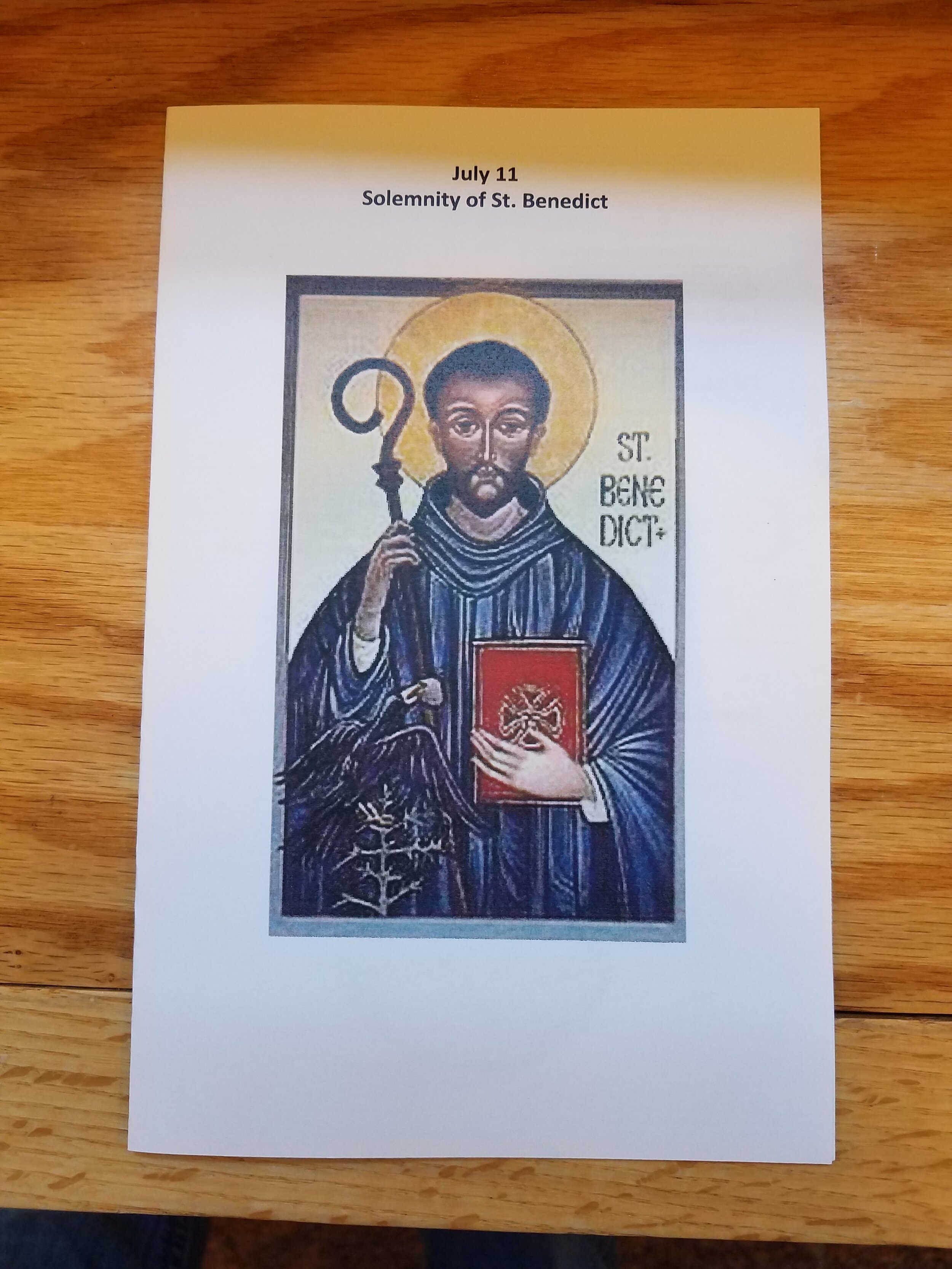
Solemnity of St. Benedict
Proverbs 2:1-9
Ephesians 4:1-6
Luke 22:24-27
The city of Rome with its Empire had finally come to an end three years before Benedict was born. The Rome of Benedict’s day was a broken city. Its glory had faded. The city had been attacked a number of times by invaders. Foreigners were at the helm of leadership. When Benedict went there to study, he found decadence, a low moral life. He abandoned his pursuit of knowledge that he hoped to find there. He left and went off to a lonely place. Perhaps it looks like he chose to escape. But by grace, even in his youth, he realized there was another way, another path to the truth of life. Even in his youth, he was led to the realization that there was wisdom of another kind than what Rome could offer. He went to search for that wisdom. The voice that we just heard in the book of Proverbs, the voice of the wise Master, echoed in him. He followed it; he listened to it and learned the ways of wisdom that come from God. He went to the cave and the craggy mountainside to be still with himself so that truth could be born in him.
Benedict went to let that voice of wisdom claim him. He went to serve that voice that would keep him in the way of honesty, truth, humility and patience. He spent time learning the way of the Lord. But he was not called to be a hermit or a solitary. His response to the breakdown of the world, which surrounded him, was not to be just a withdrawal and a search for a safe place. Benedict found that he was called to lead and to serve others. He found that his time of solitude led him to a way of wisdom that would bind others together. His experience of the wisdom of God led him to lay out a way of life. It was not a path for others to follow so that they could escape from the moral corruption of society or its political chaos. No! The wisdom he heard in the silence was a deep knowledge about how to live genuinely. The wisdom that found a home in him gave shape to a way of living together in the heart of a fallen, broken world. Benedict’s listening to wisdom evolved into a treasure that he served up for others. The silver and gold he found with wisdom, we and the church have come to call his Rule: A guide for those who wish to live together the way of the Gospel. The gift that Benedict came to share with us was the gift of how to organize and live in a community. This was the Gospel response he offered to the chaotic world of his day, perhaps a world not unlike the chaotic and transitional world we find ourselves in.
Benedict has shared with us the fruit of his prayer and his life long experience as an abba, a father leading others who wish to live in community with Christ as the living center. His wisdom is the gift of forming a society whose rhythm, manner of life, values and priorities may definitely be different from the world around it. And yet it can speak to that world, to our world. It can say that it is possible to live in a less chaotic, less pressurized and stressful manner. It can speak to society at large of a balanced life where prayer, reading and work are the breath that both humanizes and divinizes. Benedict’s way offers a vision where the poor and the rich, the colored and the not so colored, can be with one another in a peaceful way. Benedict reminds us that the wisdom he encountered said that God had no favorites. For God there was no privileged party. Rather Benedict says we are all one in Christ. There is a center and that center for those who claim to know him is none other than Christ, the living wisdom, the living way of the Father. There may indeed be an unsettled and unsettling world, but Benedict places in our midst a person around whom we can gather, the living Christ.
And just what does this living Christ look like? What picture of him does Benedict draw? In his pondering of the Gospel and through his own experience, Benedict came to be convinced that the world as he knew it did not provide the model of leadership that could attract and hold people together. Instead, he found in the Gospels the picture, model and the method of leadership for the community. He turned to Christ the Servant.
He tells us that he is establishing a school of the Lord’s service. Service is the key word. An abba who is a servant and a community where members learn to serve each other: such is the picture we have from the Gospel of Luke today. Jesus asks the rhetorical question of his disciples: who is greater the one sitting at the table or the one serving the food? All knew the answer. Yet Jesus identifies himself with the server. In his day, the server may frequently have been a slave. This Jesus says is where you start to build a community, a society, a culture that is truly human. We are to be with each other as servants to the master. No one is the master except Christ and yet all are to be treated as though they were the masters. For we are to wash each other’s feet. Here Benedict and the Gospel proclaim that power, authority and control can turn out to be nothing but self-seeking. The Gospel way of life is, as Benedict says, different from the world’s way.
Benedict did not outline a way of life and give us model for making it happen so as to conquer the world. Benedict wants to set up a process that would supply good energy in the world. Benedictines might be well-known in some circles for preserving culture and the best in culture. That is a bit ironic. Benedict wasn’t really about preserving, he was about creating a culture and a world where human beings came first. His way of gospel living has the human person at heart. He wanted to place honor and respect between everyone; he wanted his communities to learn a language the builds up, affirms and forgives. He called us to patience with our vulnerabilities, not denying or avoid them but embracing them as the Christ did. In short, he appealed to people who were looking for an authentic life and seeking peace. In the end, all he wanted us to be was church wherever we are.
We are gathered now at the table of the Eucharist. Christ is with us and once more he will serve us with his very self. He is going to serve us with his love. When you and I partake of what our servant Christ offers, we are saying yes: This is our way of life too. We are simply in a school of life learning how to place others’ needs ahead of ours and thus be children of the one Father who is over all and through all and in all.
~Prior, Fr. Joel Macul, OSB
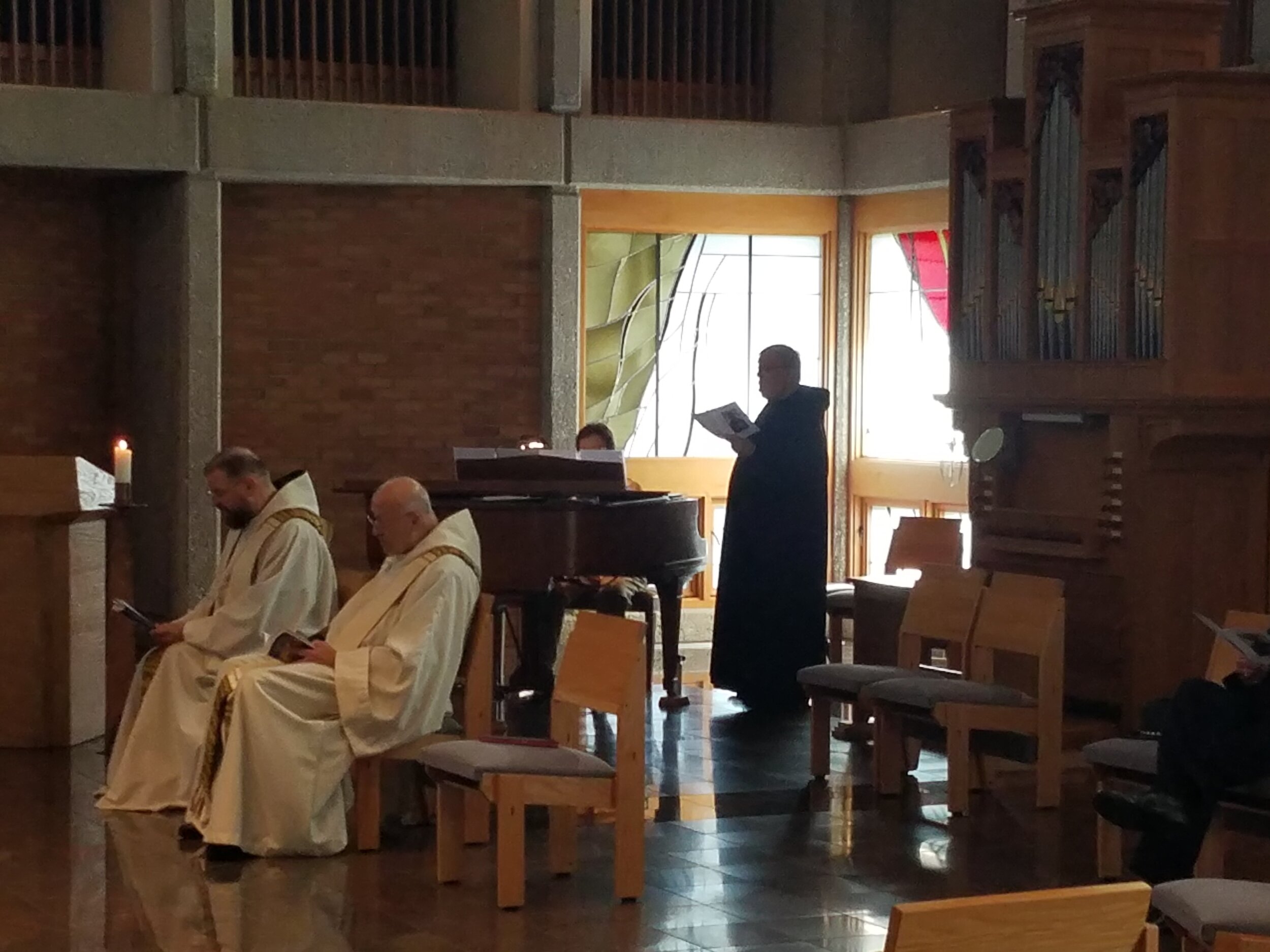
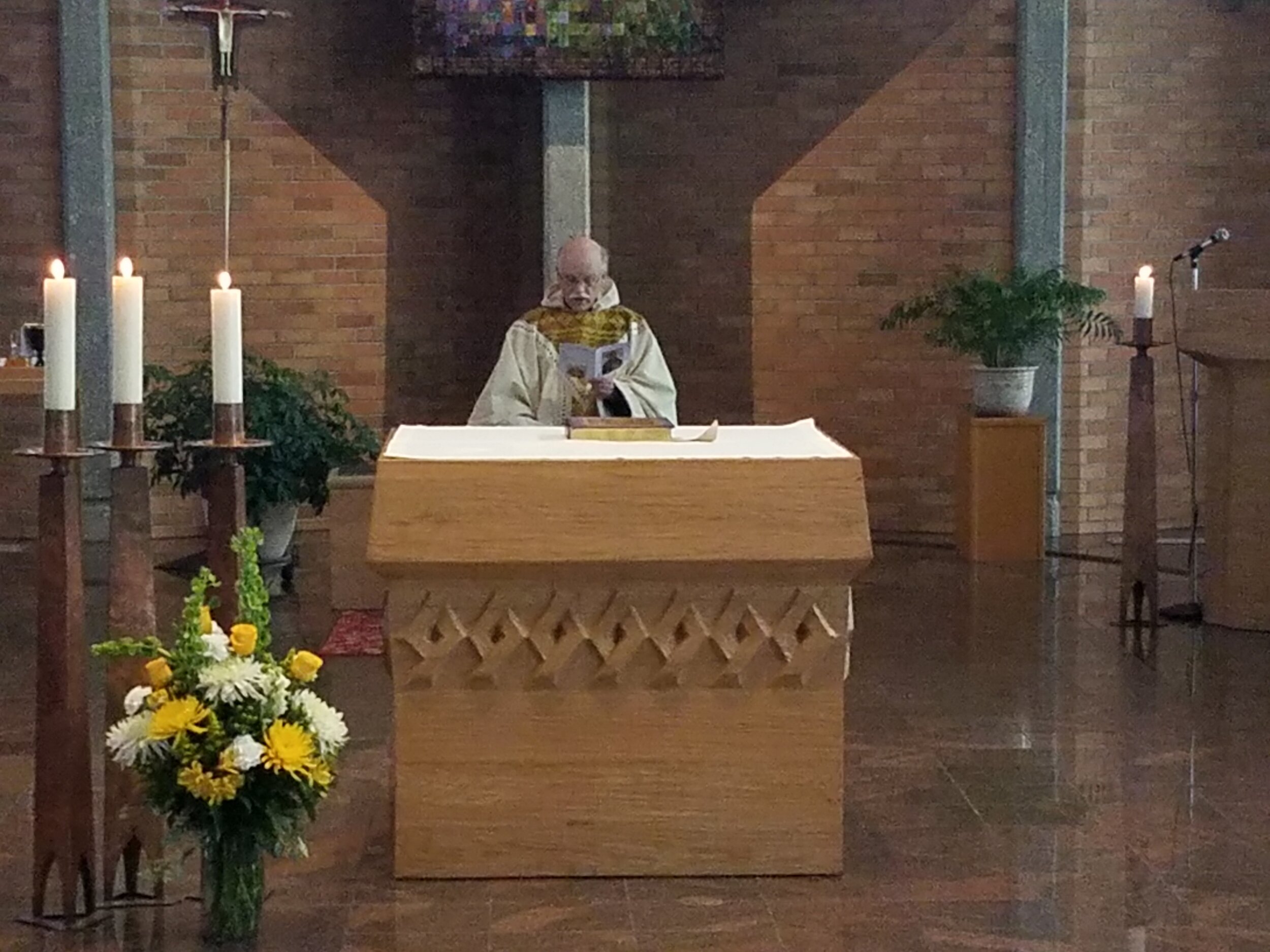
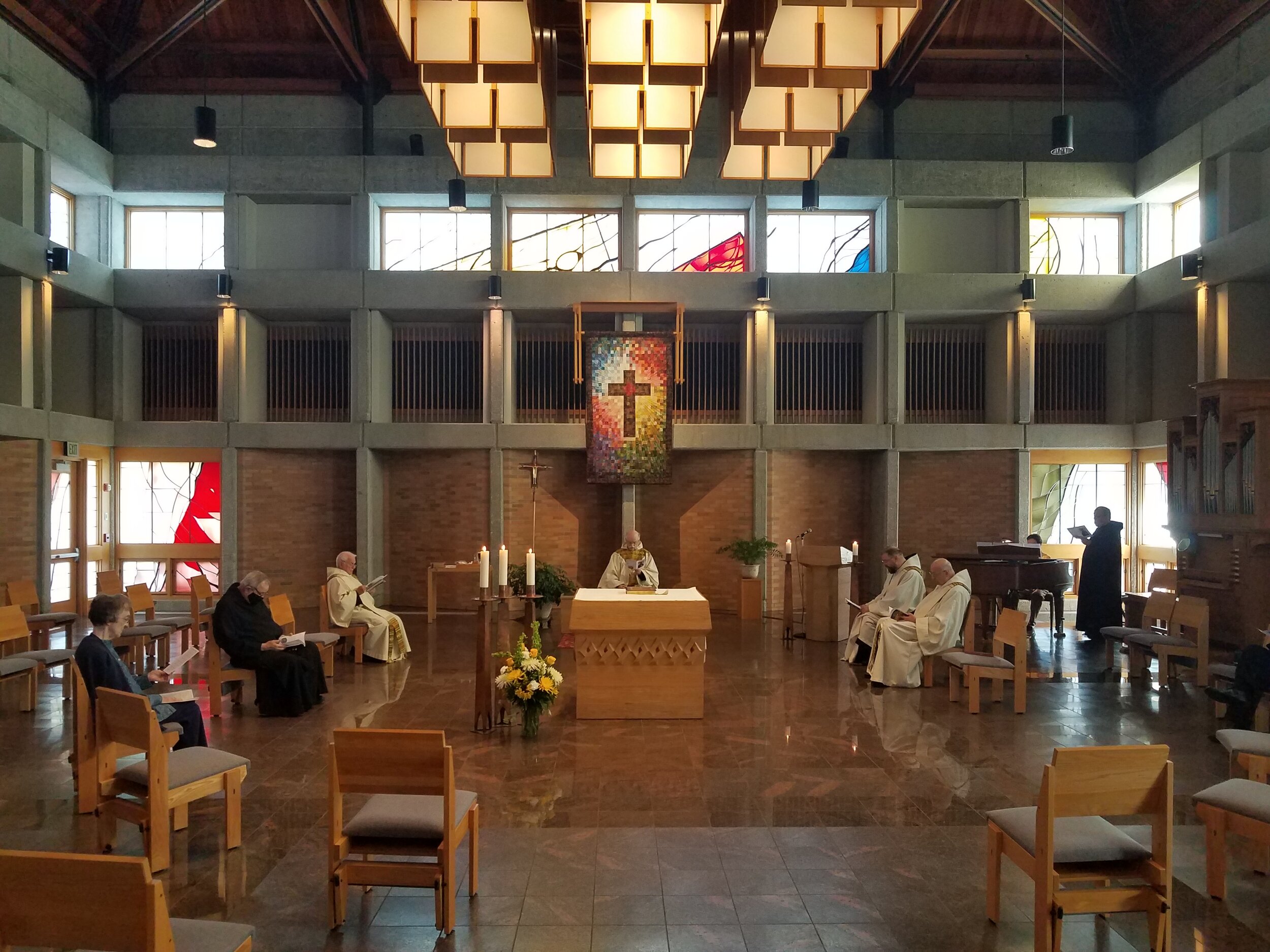
14th Sunday in Ordinary Time
Fr. Adam Patras, OSB - celebrant
13th Sunday in Ordinary Time
Fr. Tom Hillenbrand, OSB - celebrant
Nativity of St. John the Baptist
Isaiah 49:1–6
Acts 13:22–26
Luke 1:57–66, 80
When we first hear this story of John the Baptist’s birth, we easily recognize the main characters: namely Zechariah, Elizabeth and, of course, their newborn child whom they name John. Indeed these people stand out. But if we listen closely we will hear also what the film world calls the supporting actors. It might be well to remember that in some cases the supporting actors get the reward. Among the supporting actors today are the neighbors and relatives of Zechariah and Elizabeth. And perhaps they give us a real clue as to what is happening in the story. And perhaps they are our entrance into the story. After all, we are not John nor his parents. But today we are those who are present to the events.
Unknowingly perhaps, it is the neighbors and relatives who give the real title to the story. They recognize that this is a story of mercy. They hear in this birth story that God has shown mercy to the aging Elizabeth. And this brings them joy. What are we about on this birthday but recognizing that the mercy of God has broken into the world. It has appeared in an unlikely place. It has come at the end of a couple’s life, not in their first fervor of love or youth. It has come when we would all say it is impossible. God’s mercy has arrived in the midst of a life time of shame for Elizabeth…her identity on the outside is as a barren women, passed over by others. Perhaps even been considered cursed. Now God has shown his face and she has given birth to a son.
God’s mercy comes at a time and a situation when we least expect it. We must give credit to these supporting actors. They hear and confirm that God’s mercy is visible and they give us the model of response to this mercy: rejoicing. They set the tone for the event. This is a day of joy. It may look simple and even backwater..an old woman in the hill country gives birth to a son when nature and humans have said impossible. They are happy for her. Being happy for someone else’s blessing, how wonderfule.
For you and I this birth is part of the great story of God being faithful to his covenant. God’s fidelity looks like love shown in dire straits. And we, we rejoice at this visibility of God’s love. This child means that God can transform a dying age and bring new life out of it. Our God’s mercy is precisely at work when things look the worse and even when we neighbors and relatives have written people and situations off, as dead ends. But John comes as a sign that says, yes, I am the last of the prophets because a new age has come, a new prophet is coming. I may be the last but the last will usher in the first, the new. The last is not without fidelity, patience and hope. It is out of the last, the end of the line that a new beginning is created.
But the neighbors and relatives also don’t quite get the whole picture. Yet, their role is to provoke the main characters of Elizabeth and Zachariah to open their mouths and speak. They push them to identify what is really happening here. When all is said and done, it is their child at the center of the stage. And these old people, they know who this child is. Neighbors and friends what to give a name to the child that corresponds to tradition. They want the child to be the next of kin; they want to make sure that the child is part of a human family no matter how miraculous his birth. But the quiet and reticent old man breaks his silence. He speaks what he knows. So he and Elizabeth complete what the neighbors intuit. They speak the name; they give identity to this child: John is his name.
In the name of the child is the name of God and who God is and what God does. John means “God is gracious”. The child’s identity is given by God, it is a revelation of who God is and what God does. God’s graciousness, God’s love and kindness has begun to enter into the world. John the Baptist is the precursor of God’s final act of love to come in his Son. But today God lets us know that light is shining in the darkness of the world; it comes like first rays.
When Zechariah does break his silence, he tells us very poetically what is happening in this apparently insignificant birth in the hill country. We know his words so well because we sing them every morning: The tender compassion of our God is dawning, breaking upon us. It will shine where there is darkness and death. God’s compassion is dawning so that you and I can rise and walk. The light is coming so that the way of forgiveness and peace open up for us. Our fears are laid aside to hear and find the graciousness that is being born each day. The name of the child heralds a new view of the world and of our God in that world. No wonder Zechariah says, “Blessed be God.”
~Prior, Fr. Joel Macul, OSB
12th Sunday in Ordinary Time
Mk 4:35-41
Job 38:1, 8-11
2 Cor 5:14-17
Focus: Jesus accompanies us on the journeys of our life. Whatever the chaos and the storms are in our lives, we are called to faith that He is Lord in the midst of it all.
It was over 20 years ago that I went on pilgrimage to the Holy Land, but some moments are still vividly on my mind, among them my early morning walk along the Sea of Galilee’s shore when the sun was just rising over the quiet lake.
Another wonderful memory was the boat trip across the lake. In these quiet moments many of Jesus’ words came to my mind that he spoke on the lake and by its shore.
Many people in the towns by the lake live on the fishing industry; they did then and they do today. When Jesus spoke, he made reference to the lake, to the land around it and to the people who lived in the region. He used Peter’s boat as a pulpit when the crowds became too large, and he crossed the lake many times—no doubt with Peter as his captain.
In today’s gospel, Jesus suggests to his disciples that they cross the lake to the other side. The sun has set; soon it will be night. The crowds are left behind. The lake is normally calm, but because of its position—about 700 feet below sea level—sudden storms can occur on it, which sweep down from the surrounding hills and whip up the water.
That’s what happens in today’s Gospel: The weather changes rapidly; and the waves break into the boat so that it starts to fill. In the midst of this chaos Jesus, who must have been tired from a long day of ministry, is fast asleep on the small bench at the back of the boat, his head resting on a cushion. The disciples rouse the Lord in extreme desperation and say, “Teacher, do you not care that we are perishing?” Jesus, roused, remains calm and commands the sea to be quiet. After rebuking the storm, Jesus rebukes the disciples for their large fear and their small faith.
Today’s first reading gives us a hint as to how this story has meaning for us today. Life had dealt Job a number of terrible blows: He has lost his property, his family, and finally his health. Job complains to God, but holds on to his trusting faith in God. God does not give a direct answer as to why he had to suffer all this; but God asks, “Who shut within doors the sea … who set limits for it …?” In other words: This earth is my creation. I am here. I am still in charge. Bad things may happen to you, but I haven’t forgotten you.
This passage also shows us who Christ is for us. Once, in the beginning, God has brought forth creation out of the waters of chaos. Christ can do what God does: still the “proud waves” of the sea—even today. Christ can order the waters of chaos within us, he can bring about peace in us and in our lives.
My sisters and brothers, Jesus accompanies us, too, on our life’s journeys as he did with the disciples in the boat as they crossed the Sea of Galilee. Whatever the chaos and the storms are in our lives, we are called to faith that he is Lord in the midst of it all.
In today’s second reading, St. Paul adds to this message: Christ has already done so much creative work in us! In him and through our baptism, we are a new creation. Evagrius Ponticus, the writer among the desert fathers, the early Christian monks who lived in the deserts of Egypt and Palestine,
considers this line of St. Paul a remedy against sadness: “Whoever is in Christ is a new creation. The old things have passed away; behold new things have come.” This can be a good prayer word for us, too, when we fall back into old, unhealthy patterns of thought or behavior: Christ has begun to make us new. He can help us to leave behind what isn’t good for us and what obstructs our freedom. Whoever is in Christ is a new creation. The old things have passed away; behold new things have come.
Storms are unavoidable in our lives: difficult people with whom we work or live, illness, the death of loved ones, trouble due to personal weaknesses or sinfulness…The comment of the disciples when Jesus has stilled the storm is another prayer word that helps me in such situations: “Who is this whom even wind and waves obey?” There is One who can restore the inner calm.
And here is a third line that we heard this morning, which has frequently accompanied me in the course of my day, now again from St. Paul: “The love of Christ impels us.” Because of God’s love that became so visible and tangible in Jesus Christ, I can no longer live for myself. I must imitate him in doing good. This is crucial, too, for my becoming NEW, for your becoming new, ever more completely, through and in Christ. The love of Christ impels us to think, to talk and to act as he did.
AMEN.
~Fr. Thomas Leitner, OSB
11th Sunday in Ordinary Time
Ezekiel 17:22–24
2 Corinthians 5:6–10
Mark 4:26–34
Today we slip back into Ordinary Sundays as we call them. Along with this, we return to our Sunday reading of the Gospel of Mark. Today we find ourselves at the very end of Chapter 4. This chapter is a collection of various parables. We hear Jesus coming to the conclusion of his speaking to the crowds and the disciples in this manner. All of the parables in the chapter come from the farming and agricultural world. Jesus recalls the sower, the seed and the soil and the growth process in their interaction. Each time he focuses on some aspect of the process.
We need to recall the last lines of Jesus today. He chose to speak to the people in parables. But with his own circle of disciples he took time to open them further. The parables look like they are pointers on how to plant and what to expect. But we realize that they are really about the Kingdom of God. Jesus and his audience were familiar with planting from the seed dropped into the soil to the harvest. What was new was Jesus proclamation of the Kingdom of God. That is more elusive that planting a seed, but it is just as real. Jesus choses the familiar world of planting to introduce an unfamiliar world of the Kingdom.
We, too, need to know something about the world of a parable. At first glance, it may look like a little story about some human experience. And it is; but inside it is really pulling us into a different world that Jesus calls the Kingdom of God. A parable is not just some neat story. It is meant to bring together the familiar and the unfamiliar. But the unfamiliar is in reality bigger than the stuff in the little story. What the story describes is “like” the Kingdom of God. The parable is not always clear at first sight and it is not meant to be. The Kingdom of God cannot be contained in the mustard seed and it cannot be contained in the natural growth process but the Kingdom is “like” both…Parables depend on our imagination. They tease us and call us to see more than what is there. A parable does not really explain anything; that would be rational. Rather it opens up possibilities and invites us into them. It is always best not to make different elements in the parable mean only one simple thing. It can mean many things. And the meaning will grow as we grow in in our human experiences.
In both parables today there is a definite growth process. And in both parables there is a sense of mystery as to how this happens. If a farmer or a gardener were to plant a seed and then go each day and uncover the soil to see what happening down there, the seed would not germinate. But if the gardener lets the seed and soil and water work while the gardener is carrying on with life, the process takes place. We might be trying to watch or control our own growth process—analyze it, dissect it and in general be in charge over it. Nothing much will happen. The parable says that the gardener does what he or she can but then lets the seed go to work. And Jesus says, “he does not know how.” Perhaps that is the catch. There is a mystery in how God works with us human beings. Once the seed of the Word is planted in our hearts something will happen; Jesus assures us of that. The seed of the Word might look like we do all the work with it, but in the Kingdom, God is part of that process of growth. We have to allow God to work the mystery of his life within us.
Life in the Spirit does not always go on or work out on our time framework. Or the results may not look like what we expect. If we are standing in the Kingdom world then we ought to let mystery into our lives so that the growth we desperately want will actually occur. If we are not living from the Kingdom perspective then we might judge others when we see growth in the Spirit not going fast enough. Or even we might dare to judge it is not growth because we are applying our categories of growth to that person or to ourselves. The parable reminds us that spiritual growth is a process and that God and the Spirit are part of that growth. And the parable asks us if we can admit that there are some elements of our own lives as well as those of others that “we do not know how.” There is mystery in our lives. Parables affirm what we might know, but they also challenge us to the mystery that lies in the Kingdom.
One aspect of the Kingdom’s mystery is really rather old when we listen to God’s story of interaction with his people. We like things big. This is the Kingdom of God, so it must be big, grand and popular, right from the start. But our God does not work that way. He is not about planting fully-grown trees. No, he starts with what is small. Ezekiel sees God replanting his people symbolized in the tree. But he doesn’t start with the mighty cedar, he starts with a twig. This, in time and with care, will grow. Jesus says that the Kingdom, which implies in human terms something rich, famous, grand and visible, this Kingdom really starts with the smallest of all seeds. Then from the smallest, shall we say in terms of people, the weakest, the marginal, the impossible, comes what God wants, arises God’s Kingdom, his way of life.
And what does God want? Well, at least we can use our imagination and see that in the mustard seed become the largest of plants; we can find birds of the sky making a home within it. Does this mean that the Kingdom is a community, a flourishing plant or tree, that stretches out branches to hold and shelter all kinds of people? What can this image say to us of the kind of Church, the Body of Christ, that the Father is cultivating? Is it perhaps a community that is open to holding the rich variety of human beings that inhabit our home, the earth? If this is so, then the harvest will be great indeed for the variety and diversity of the members of humanity is really beyond our comprehension. It is hard to imagine such a Church. But yet, hidden in the mustard seed and seen as our God sees it, it is possible and Jesus assures us it will happen. Why? Because it is about the mystery of the Kingdom, a mystery that leads us into what at first we do not see or even imagine.
Paul says today we walk by faith. Jesus comes and speaks in parables. These tease our faith. What is familiar but seems insignificant, weak or even ignored becomes, when seen in the Kingdom, a new and marvelous world. We can enter into the Kingdom world and follow its vision only if we walk by faith.
Our gardener God is always sowing seed where he wills. The Spirit blows and we do not know where it comes from or where it is going. But what we can do is enter into the mystery of the growth process of a little seed and the gentle breath of the Spirit. Jesus says over and over again, if you have ears, listen to the Word. The mystery begins its work when we listen to the parable.
~Prior, Fr. Joel Macul, OSB
Solemnity of the Most Sacred Heart of Jesus
Hosea 11:1, 3–4, 8c–9
Ephesians 3:8–12, 14–19
John 19:31–37
Most pictures of the Sacred Heart emit a sort of warm glow. Jesus’ heart is open, his face is inviting and we are pulled into the burning warmth of his heart. In contrast, the description of the death of Jesus in today’s feast day gospel reminds us of the stark reality of the crucifixion. John leaves us in no doubt that we are facing a Jesus who has died; his body has been pierced with a soldier’s lance to make that perfectly clear. But John makes us linger at the cross and look at the one who has been pierced.
There is death here but there is more. For those who look on this death and hear the gospel writer’s words there does open up a new level of meaning. John gives us two symbols of Jesus death. In this way, his death begins to reveal itself in all its depth. On Good Friday there was little time for us to gaze and ponder. We had to bury, to complete the process of death. But today is the day to take time to look with the evangelist and see what he sees.
The first symbol is simple enough. The bones of Jesus are not broken. Breaking the bones of a crucified person expedited the death. Jesus is different. Jesus has said that he lays down his life of his own accord. No one takes it from him. Jesus accepts death as his mission. He accepts it in obedience to what the Father asks of him. Jesus’ bones do not need to be broken. He died out of love for his Father. You and I did not take his life from him despite what it looks like. And, when John references scripture in regard to non-broken bones, he is pulling us into the mystery of the Paschal lamb. It was to be eaten whole and no bone was to be broken. Jesus is the Lamb of God whose unbroken bones take away the sins of the world. The death of Jesus means reconciliation with God for all humanity. In this lamb Jesus on the cross, God has brought together the divine and the human. The whole Lamb means the unity of the relationship you and I have with the Father. Jesus death brings about unity in relationship. Death looks like separation from our point of view; in Jesus it means a unity restored. Jesus’ final prayer for unity is being answered.
The second symbol is that out of a dead man’s side blood and water are coming forth, like a spring. The body instead of holding death is emitting life through two powerful symbols, water and blood. We are with the woman of Samaria at the well: Jesus offering her the spring of water gushing into eternal life. We are at the last supper: whoever eats my flesh and drinks my blood will have eternal life and I will raise them up on the last day. This is my blood that will be poured out for you and for the many.
Christians from early on have always seen in the water and blood the symbols of baptism, Spirit and Eucharist. Where do they come from, how are they given to us: in the death of Jesus. His death is life-giving. When Jesus appears after the resurrection, what does he show his disciples but his wounds. These wounds are the source of our new life. His pierced heart holds the profound mystery of our Christian faith. Pierced to make certain that he is dead, it opens up into life for us here and now. It is life in the Spirit that is hidden on the cross but by the gesture of a non-believer reveals what is truly within.
Today we gaze upon the unbroken body of Jesus and a pierced heart. But ours must be more than a gaze. For the Eucharist is a here and now event. At every Eucharist, the death of Jesus is opened and life is revealed. We share the bread and drink from the cup, yes. And then slowly our lives are transformed by this to become a washing of one anothers feet and a laying down freely of our lives that others too may enter into eternal life. For what is hidden behind this death with unbroken bones and blood, water and finally Spirit is a body filled with love. It is this body of love that is to be the foundation of our lives. And our Eucharist is where the heart of Jesus satisfies our longing for love.
Prior, Fr. Joel Macul, OSB
Corpus Christi Sunday
Fr. Volker Futter, OSB - celebrant