

Fr. Adam Patras, OSB - Celebrant
18th Sunday in Ordinary Time - 2022
Fr. Anastasius Reiser, OSB - celebrant
In our St. John's Bible, which we have on display in the entrance area, there is a beautiful illustration of the parable of the sower in the book of Gospels (Mark 4). We all know this parable that Jesus tells us, a sower who sowed his seed. You remember, part fell on rocky ground, part among thorns, and a good part on good ground. (Mt 13:1-9)
Then the gospel continues and the sower took care of his field as a good farmer should (Mt 13:24-30), he worried about who had sowed all the weeds in his field. Then he watched the wheat and fruit grow as it is.
Now we come to the gospel of today and the harvest time is coming and he sees that it will be a good harvest. His work and care are rewarded and he imagines in his heart what it will be like when he has harvested. He could rest and enjoy what he now has in his barn because it will last for a few years.
And in that moment God answers him in the parable that that is not wise, because he could still die that same night and would not have any of the wealth he has accumulated.
Well, what has changed in the sower since he started cultivating his field?
Do you remember the time when you sowed seeds without machines? I think most of the farmers are using nowadays seeders to sow their corn or wheat. These machines are more accurate and you can set exactly how much wheat needs to be planted per acre so that the optimal amount of corn can grow in the field. But my grandfather and my father still sowed the grain by hand in smaller fields where large machines could not be used. When my father taught me that too, he told me that the most important thing when sowing seeds is that the hand must be opened!
And that's true! One cannot sow if the hand remains closed. You can’t make a fist! You have to give the seed away, be willing to let it go. Like the sower in the gospel, when you sow the seeds, you don't have to worry about what will happen to the wheat. You have to let it go, a trust in what God is going to do with the seed. No matter if a part falls under the thorns or on rocky ground. When the farmer sows, he doesn't worry, he has faith that it will grow.
Likewise, when the plants are growing. Even then he will remain relaxed and let the weeds grow with the wheat. He will not be overly cautious in plucking at each little seedling to encourage growth. Furthermore, he cannot decide how often it should rain. Even in this state of field work he will remain calm and trust in God, who has everything in his hand.
And now comes the point where this farmer stops keeping his hand open. It's okay that he's happy about the harvest. But he folds his hands in front of his belly, wants to stop working, wants to build a bigger barn and then have a carefree life for himself. What is interesting is that he concludes inwardly that he no longer wants to take part in the dynamics of life – and that his hand is now closed! His hands were fully open during the harvest, now they are closed!
And this is the part of the gospel parable where God intervenes and says: stop! When we don’t want to stay in the flow of life and only want to live from what we have, are no longer willing to reseed and no longer want to share with others, God intervenes and says stop!
We humans naturally want to stay in the flow of life. If we stay in life and our everyday life is in a good flow, then we experience ourselves as content. This is contentment about work, about processes that are changing, about growth and movement.
We know from our life experience that this is not always the case. There are crises in life, problems that we have to solve. But that is also part of life and challenges us to stay in the flow of life. But even in such situations: If we master such situations together, then in the end we can be satisfied that we made it together. Here, too, it is important to keep one's hand open for people and to seek and find solutions together with others.
If we look at the Rule of Benedict, we will not find any standstill in life.
The cellarer gives what the monks need to live. And even if he has nothing to give, then at least a good word. So that life keeps flowing and the monk doesn't leave sad, i.e. cut off from the flow of life.
When the abbot has something to discuss, he calls the community together and discusses it with them. He doesn't figure it out on his own. Here, too, he opens his hand and wants to solve the problems with the others.
The superior in the monastery has a feeling for the life flow in the monastery and Benedict says that only then he can be happy when "the flock entrusted to him is allowed to grow". So here, too, contentment only when the community is on the way, when there is change, when life is pulsating.
A contentment that is actually self-righteousness is not a condition that gets you anywhere. That would be a condition that excludes and cuts you off from living with others. This can then also be the same as spiritual death.
Death as the end of life is actually addressed by Benedict only when he speaks of the end of life as a learning process: Lifelong learning in the monastery as "a school of the Lord". Benedict says: We remain in the school of the Lord until to the end of our live. This means that we remain in the dynamic of life permanently.
This is exactly what we do as Missionary Benedictines. Sharing with others what we have. To do it like the sower, the hand must open up, the seed should fly properly so that it can spread everywhere. (And if you look later at the illustration of the St. John’s Bible you can see how the seed are flying between the other words.) We try to show that in our hospitality but also in our missionary work in Africa, where we sow the Word of God, build schools and help the sick people in our hospitals to get well again.
We cannot sit back and relax. When the harvest has been brought in, the next year is waiting for us and continues with sowing new seeds and with the circle of life.
Amen.
~ Fr, Anastasius Reiser, OSB
17th Sunday in Ordinary Time
Today’s Homily - by Prior, Fr. Joel Macul, OSB
Genesis 18:20–32
Colossians 2:12–14
Luke 11:1–13
Luke often presents Jesus as a model of how a disciple is to act. Today Jesus is the model for a person who prays. A disciple sees Jesus praying and asks him to teach them as well. What we hear then is a sort of summary about Jesus thinking on prayer.
The basis of prayer is quite simple. It is a form of communication with someone whom we believe is the source of life and from whom we draw life. Prayer implies a relationship of some familiarity and openness. It is easy for us to say that prayer is communication with God because he is the source of life and so is bound to us who come from him. But consider some other factors that influence how we understand God. How much in charge of life is God? Don’t you and I have a lot of control over our lives today? With our science and technology, we can solve a lot, we can supply a lot. We have a knowledge that says, I know where this comes from or how this works. We have achieved a lot. That is all wonderful. But at the same time, we have reduced the areas in which at one time we took for granted that God is in charge. Only in extreme cases do we find it necessary to turn to God.
Consider another factor of present-day life. Much of what we do is instant. We get instant results in many areas. And we want instant results in many areas. We press a button and we get a person on the other end. We touch a key on the computer and up comes the relevant information. Maybe we have a crisis—someone unexpectedly ill, an economic need, a death by accident, so we pray. Do we carry with us the expectation of instant results in prayer? We ask, so we expect to receive today. And notice our impatience in ordinary things when we call for service and it is not forthcoming very soon. Do we pray and have expectations of how we should be answered? We know what we are looking for, so is that what we should go for? Is that what we need?
In the readings today we get some intriguing images of what prayer is all about. Abraham seems to be haggling with God. Abraham knows very well that God is in charge. God has stated his intentions quite clearly. He is going to see things for himself regarding Sodom and Gomorrah. Abraham knows what he’ll see and what he’ll do: destroy the whole city and population. But Abraham starts to bargain with God. Abraham comes across as a good Middle Eastern buyer who won’t let up until the price is within range or what it should be. So Abraham bargains for God’s justice and faithfulness to even the few. And he gets it down to ten good people and the whole will be spared. He appeals to God as God. It looks like a merchant and a buyer in a Middle Eastern bazaar. But Abraham knows that he is talking with God, the final authority. But he appeals to the best of what God is—the one who saves for the sake of a handful. The end of the story is that Abraham and God each make out. God does bring justice and Abraham at least knows that mercy is shown even in a situation that is dire and facing doom.
Is prayer about haggling and bargaining? Perhaps, as long as we know that God will be God in the end and I don’t have the last word. Perhaps it is about haggling as long as we are haggling about God being true to himself. Abraham never appealed for his family directly. What he appealed to was God to be faithful to those who are faithful to him, even a few. Prayer to God implies that we have a relationship to the one to whom we are praying. If we call upon that relationship only when we are desperate, then maybe we will get our priorities mixed up. We may ask as Jesus tells us. But ask about what? Prayer as we hear about it today means that we can be as familiar as Abraham is with the Lord. But we can also be as unconditional and leave it in the hands of the Lord at the end.
Jesus offers two images of prayer. The first image is of a sleeping man who is woken at midnight because of a friend pleading for assistance. We might not like to think of God as the person who is asleep when we come calling. But that is the way life is. Crises come when they come. The visitor comes when they come. In an age and time when communication was slow, that could be anytime. But God is the sleepy householder who gets up and helps out his friend. He does it because he has what his friend needs. He does it because what his friend is asking for is much larger than just a personal need. Hospitality was not just a private affair; it was an affair for the whole community. If the man who was in bed refused help, it was the same as saying to the visitor, you are not welcome here! Get out and move on! In Jesus day, that was unthinkable. The arrival of a visitor was a chance for the whole community to demonstrate its capacity to welcome and share. The man’s prayer to his friend drew on what the man could offer; it drew on the best of what was expected of a fellow human being. Does it say something about our prayer to each other in the course of a day? Is what we ask of each other something that we are able to share? Will sharing it show honor and respect to another? And will it not be that by sharing it, we will honor and respect our humanity.
The other image Jesus gives us is that of a father caring for his children. When the father is doing his best, he will not cheat his children of what they ask for. He will not cheat them because what they ask for is food; namely what is essential for life. When he gives it, he will function as a true father. The implication is that a true father will not cheat his children. If he does cheat them, then he is no longer worthy of being called a father. If he cheats, not only are the children cheated but he too is a disgrace to others. Jesus implies that God is like that and more. He will not trick anyone because that is not what asking and receiving is all about. But even more, God is capable of satisfying our prayer with what we truly need. In the end, it is about need and not wants. Jesus says a human father takes care of the needs of his children, gives them food. What God gives is his own Spirit. A share in his own life. What God gives to those who ask is a share in the very fabric of what binds God the Father and Son together and what binds them both to the world and the human family.
What is prayer in the end says Jesus? It is asking God for his Holy Spirit with the assurance that he will give it us. It is the Spirit that carries with it the power to forgive, the grace to share even if what we have is small. It is the spirit that will move us to open ourselves even when not convenient. And lastly it is the Spirit that will let us stand strong when difficulties seem to overwhelm us and cut away at our security. In the end, we pray for the Spirit because that keeps us human and keeps us in communion with God, the source of all life.
16th Sunday in Ordinary Time - 2022
Fr. Thomas Hillenbrand, OSB - celebrant
Solemnity of St. Benedict
Prior, Fr. Joel Macul, OSB - celebrant
Proverbs 2:1-9
Colossians 3:12-17
Luke 22:24-27
The Rome of Benedict’s day was a broken city. Its glory had faded. The city had been attacked a number of times. Foreigners where at the helm of leadership. When Benedict went there to study, he found decadence, low moral life. He abandoned his pursuit of knowledge that he hoped to find there and went off to a lonely place. Perhaps it looks like escape. But by grace even in his youth he realized there was another way, another path to the truth of life. Even in his youth he was led to the realization that there was wisdom of another kind than what Rome could offer. He went to search for that wisdom. The voice that we just heard in the book of Proverbs, the voice of the wise Master echoed in him. He followed it so that he could listen and learn the ways of wisdom that comes from God. He went to the cave and the craggy mountainside to be still with himself so that truth could be born in him.
So Benedict went to listen to the voice of the Master. He went to let that voice claim him. He went to serve that voice that would keep him in the way of honesty, truth and humility. But he was not called to be a hermit or a solitary. His response to the breakdown of the world that surrounded him was not to be a withdrawal and a search for a safe place. Benedict found that he was called to lead and to serve others. He found that his time of solitude led him to a way of wisdom that would bind others together. His experience of the wisdom of God led him to lay out a way not for others to escape from the corruption of society but rather a way to be together in the heart of a fallen world. Benedict’s listening to wisdom became a treasure that he served up for others. The silver and gold he found with wisdom we have come to call his Rule—A guide for those who wish to live together the way of the Gospel. The gift that Benedict came to share with us was the gift of how to organize and live in a community. This was the Gospel response he offered to the chaotic world of his day.
Benedict has shared with us the fruit of his prayer and his life long experience as an abba, a father leading others who wish to live in community with Christ as the living center. His wisdom is the gift of forming a society whose rhythm, manner of life, values and priorities may clearly be different from the world around it. And yet it can speak to that world, to our world. It can say that it is possible to live in a less chaotic, less pressurized and stressful manner. It can speak to the society at large of a balanced life where prayer, reading and work are the breath that both humanizes and divinizes. Benedict’s way offers a vision where the poor and the rich, the colored and the not so colored, can be with one another in a peaceful way.
Remembering – that is what today is all about. Remembering our Holy Father Benedict today brings us back to our roots in history and in vocation. The word of God helps us to hear again what Benedict gave witness to. We are reminded that the Rule is a way of wisdom, way of life, something that is all encompassing—from when and how we get up, how we are to sit at table with one another, to how we divide our day and how we listen and speak to each other, how we welcome those who come to us. We are reminded that we are living in community; we follow Christ in the midst of others. Humility is the virtue that will surface in us as we rub against each other in Christ; and forgiveness must be the attitude that governs what we cannot change or we do not like in others.
And then, we remember service, service modeled on that of Christ, the table waiter. That is how leadership is to be exercised and how the members are to be toward one another. We learn this in the monastery, in the school of the Lord’s service. It is all an ideal, an ideal for us as Benedictine monks who are living under a Rule and an abbot. But today is a day to recall, to remember the ideal as a challenge for us to continue to put on our new life in Christ. It is also an ideal that our world longs for. Today reaffirms our witness in a society where families are fragile and individualism triumphs over solidarity and the good of the other. Today we are confirmed again in our vocation and in our witness. It is a day to take courage. A day to listen again to the wisdom of God in our ancestor and our father, Benedict. It is a day to remember and give thanks for the treasure of wisdom, the wisdom of Gospel living, that has been handed on to us.
~Prior, Fr. Joel Macul, OSB
15th Sunday in Ordinary Time - 2022
Fr. Volker Futter, OSB - celebrant
14th Sunday in Ordinary Time - 2022
Fr. Thomas Leitner, OSB - celebrant
13th Sunday in Ordinary Time - 2022
Fr. Adam Patras, OSB - celebrant
Feast of The Most Sacred Heart of Jesus - 2022
Prior, Fr. Joel Macul, OSB - celebrant
Ezekiel 34:11-16
Romans 5:5-11
Luke 15:3-7
We are invited this year to grasp the image of the heart through the image of the shepherd. Instead of the heart of Jesus being up front, so to speak, we have the sacred shoulders of the shepherd.
Jesus gives us the beautiful picture of a shepherd looking for a lost and missing sheep. The shepherd finds it and then takes it up on his shoulders. It is all so simple and so natural. It was so striking that one of the first representations of Jesus himself in art was that of a shepherd carrying the sheep on his shoulders. What Jesus is trying to do is to get us to look at the connection between God and the lost. To do this he pulls at the human experience of pasturing. On the one hand, we might take it for granted that a shepherd would go off to find one out of 100. But really now, from the point of view of the market and trading, would the investment in one that had gotten lost really pay off. It might be just as well to loose the one and have the 99 than take time and effort on one. What is one among a 100? But Jesus asks us to reconsider. The theme seems to be that God will not be satisfied unless there is a whole. The community of 100 matters and if one is missing then the group is somehow broken. The community is supposed to be made up of the 100 not 99. So the concern of God is shown to be concern for the whole. The attitude that one sheep got lost and that is too bad does not seem to fit the way God deals with the community. God’s concern is for the lost. Not only is God concerned for the lost, his joy is reflected in having a celebration for the one who was found and is now part of the whole community again. God is happy over the lost being found not the lost being forgotten.
All this is to stress how the heart of God works. All this is to make a point that God’s approach to the brokenness, the lostness of the human situation may be far different from our own. The small picture of the shepherd lifting the lost on to his own shoulders and carrying it back is a picture of tenderness and care. It is certainly not the picture of someone scolding and upbraiding someone because they got lost, went astray, broke rank, and ran away from the group. It is a picture of concern; it is a picture of a shepherd who wants his flock together; he wants everyone who has been entrusted to him to be living in unity. The ultimate purpose of God is not excommunication for doing something wrong, but rather an ingathering a welcoming back, in fact a rejoicing when a stray is picked up and made one of the group again. The heart of God is shown to us by Jesus as he stretches out to include what might naturally be allowed to disappear.
The prophet Ezekiel fills out this picture of the shepherd for us. There we have to imagine our selves as in a hospital room after surgery or serious illness. Here the shepherd is the doctor or the nurse who comes in to check on the wounds, to change the bandages and put on the ointment. Here the shepherd is the physician who is involved in healing. I myself will do this God tells the prophet. God is the nurse, the health care worker. The image of the heart is placed next to the image of the nurse, the doctor. Again, the focus is on life, on healing, on being restored to the community. God protests that he will not let his sore sheep wander in the mists of the hills. He wants them back whole and hearty. Again the focus is on gathering in the scattered, on making the community. The heart of God is stretched to be all embracing. The heart of God has a thought for what is in the darkness what is in the mist. We might run from the shadows, from the rains and the darkness, but God chooses to look there. What is in there must be part of his family, his gathering, his church.
This shepherding of God is made visible in Jesus Christ. That is what our feast proclaims today. The heart of God which is all embracing, the heart of God which is about concern for the weak, the heart of God which is about holding the wounded and the healthy in the same community; the heart of God which is about keeping the virtuous and the lost in touch with each other—that heart is made visible in Christ. And its visibility is offered to us in the concertinas of the actions of a good shepherd. Christ is that Good Shepherd. And when his heart is broken open upon the cross to reveal its depths, what do we find but a source of healing and new life flowing from his side. And what do we hear about that self-offering on the cross? When I am lifted up I will draw all people to myself! The heart of Jesus poured out upon the cross is the place of the gathering of all, the strong and the weak, the lost and the found. It is on the cross that the Good Shepherd lays down his life and gives witness to the love of the Father. It is on the cross that the shepherd ultimately carries on his shoulders the lost, the woundedness, the burden of the world and its peoples. The picture of the shepherd with sheep on his shoulders is completed by the shepherd on the cross. There on the cross the heart of Christ became the center of the world, reconciled and at peace. There on the cross God proves his love for us. Shepherd, heart, cross, Christ–this is mystery that is before us today.
Nativity of St. John the Baptist
Prior, Fr. Joel Macul, OSB - celebrant
Isaiah 49:1–6
Acts 13:22–26
Luke 1:57–66, 80
A birth brings joy. New life has come into the world. We feel it today in the gospel story about the birth of John the Baptist. The parents rejoice; their barrenness has been wiped away. The villagers join in the rejoicing. The villagers and relatives are so excited. They want to have their say in this wonderful blessing. When the eighth day comes to name the child, that is to say, to give him his identity, the relatives and villagers seem to know what to do, what the name will be. It was understood that one’s identity is in the name. They will name the child according to tradition.
At this point the domestic scene gives way to another story. The reaction of those around moves from rejoicing at the blessing of a birth to amazement and fear. What is really happening here? When Elizabeth and Zechariah insist that the baby boy is to be named “John”, all know that the birth is out of their hands. This is not just a usual domestic scene; this is a work from on high.
This is a God-event wrapped in a birth story. The family and relatives are right to say God has shown his mercy in this birth. And that mercy is to be part and parcel of the name of the child: John, God is gracious. What we are celebrating today is the graciousness of God. God is being faithful to his promise and to his word. In this child, the God revealed as mercy and kindness on Mt Sinai is now moving to live even in the domestic life of a family— And then beyond the domestic scene into the world at large. This child is a Spirit-filled person, one whom God has formed in the womb and one whom God has named. The parents, the relatives, the villagers find themselves swept up into a story of mystery.
The birth of John the Baptist is God’s work, God’s blessing to an old couple. The parents, Elizabeth and Zechariah, the relatives and friends suddenly realize that the God of Abraham is acting again. What he did once for Sarah and Abraham, the old couple, he is doing again. But the birth of this child has implications far beyond the local village. It is a blessing in that through them God is keeping his promise to visit his people. The herald of God’s visit is born. God is coming to live with us. And that is cause for awe and rejoicing. They are witnessing what many of the ancestors before them waited for and longed to see.
When Zechariah writes the name on the tablet, when he writes “John is his name” he can talk again. His silence is broken. He breaks into song to say that the tender compassion of our God is dawning, breaking upon us. It will shine where there is darkness and death. God’s compassion is dawning so that you and I can rise and walk. The light is coming so that the way of forgiveness and peace opens up for us. Our fears are laid aside to hear and find the graciousness that is being born each day. The name of the child heralds a new view of the world and of our God in that world. No wonder Zechariah says, “Blessed be God.” In the words of an Advent carol, “Love is at the door.”
Our human tendency is to domesticate the prophet, domesticate the Word. We are happy to receive this word, but in the end, like the relatives, we want to take charge of it, we want to name it. But our God won’t let us. That is what this birth of the Baptist is about. Rejoicing that something new and wonderful can happen beyond our expectations, but at the same time realizing that God has a story to tell, God has a presence in our lives. But it is always his presence, his grace. “God is gracious” is born today.
Where is the graciousness of God breaking into our lives and into our world today? Can we rejoice in its arrival even if it is in simple quiet domestic settings? Can we rejoice when we see God’s blessing happening in the lives of others? Are we heralding the arrival of the God of mercy? “God is gracious is born today, love is at the door” Let us join the relatives and villagers and wonder: What can such graciousness mean for our lives?
~Prior, Fr. Joel Macul, OSB
Solemnity of the Most Holy Body and Blood of Christ - 2022
Part 1
Part 2
Genesis 14:18–20
1 Corinthians 11:23–26
Luke 9:11b–17
Food and drink. Very ordinary, very simple. Very necessary. Without them we die. Stop eating and drinking and we will soon be having a burial. The word we have just heard is all about food, the ordinary food of that time: bread and wine-fruits of the earth and vine. The priest Melchizedek wants to give thanks for Abraham’s victory and so he brings out food, bread and wine the text says. St. Paul reminds the Corinthians of what Jesus left behind as his farewell gift, the stuff by which to remember him. And what is it: bread and cup. Ordinary food into which he put himself as it were. This food Jesus left behind would become life, a way of life for those around the table. If food is necessary, then the food of Jesus is necessary for his followers. Otherwise, we are headed for a sure death, death of spirit and body. And finally, today our Gospel story of the marvelous scene out in the open deserted country. Many people, and little food. Only 7 pieces of food can be found in the crowd of 5000. Bread and fish, the staple food of a lakeside community and the impossible odds of making such little ordinary food keep alive a crowd of 5000. But in the hands of Jesus and with the blessing from God the food is enough and more.
Ordinary food and drink, bread and wine, and in the gospel a few fish. Nothing elaborate, nothing special, just ordinary food---and yet in each case a moment of new life and opportunity for staying alive. It is wonderful how Jesus can use the simple things of ordinary life to make his points. A lost sheep, a lost coin, a farmer sowing seeds, a tiny mustard seed, a lost son who comes back to a welcoming father, a servant who is faithful to his master through thick and thin: all language to speak of the Kingdom of God, to speak of where to find God’s activity in the world. Today someone’s supper of five loaves and two fish, or a picnic lunch becomes a moment when God nourishes his new community in a new desert of loneliness and hunger. It is in the simple ordinary things, words and actions that God’s mighty deeds are made known and continue. At the end of his life, Jesus eats with the 12 and picks up a loaf of bread and breaks it and shares it, and then says: from now on you will find me with you in the bread and in the cup of spirit-filled wine. Everyday food now filled with a life and power beyond imagining.
This feast of the Body and Blood of the Lord is a feast about Jesus taking up the ordinary sustenance of human life and transforming it into himself, transforming it into the very means by which we experience God’s sustaining, nourishing and feeding us. The Gospel writers have preserved the story of Jesus feeding thousands in an open, deserted place six times, one for each Gospel and twice in 2 gospels. It is the only miracle story that told so many times. Not even the story of Jesus’ death is told so many times. Why is this? What is the fascination of this event? It may be simple: food speaks to us humans in a way that nothing else can. Eating together and sharing food and drink with one another is not only something that keeps the body alive, it is something that keeps the human spirit in us alive. The sharing of food not only binds those who eat together, but hidden in that communion with one another is communion with God himself.
The numbers in today’s Gospel are significant. It is not just anybody who comes to realize the critical nature of the situation: it is the end of the day, people are hungry, and there is not much to go around—5 loaves and 2 fish for 5000. It is the Twelve who bring this crisis to the attention of Jesus. It is the Twelve, the 12 leaders of the new community of Israel that are concerned for the needs of the 5000. Here is the leadership of the Church showing concern for the community at large and feeling helpless with what is at hand. Here the new community, like Israel of old, is in the desert and hungry on their journey. And here in this lonely place manna will come again from the hands of God. But the community is not totally helpless. What is new in this desert feeding is that God uses the ordinary food at hand to feed his people. 5+2=7, the number of the days of creation, the number of perfection and wholeness. Creation and we humans come together with God in Jesus and thus the larger community is fed and satisfied. What is essential in this meal is that we share. Jesus invites the 12 to feed the people themselves. Don’t buy; money is not necessarily the way to handle the deep seated hunger of people. Don’t buy, share; you have what you need within you. You think it is a lack and insufficient what you have. But it is not. The feeding story of the people is a meal story where we learn about how to satisfy the hunger of others; we learn something about eating. We share what we have; Jesus takes our sharing and then shows us how to bless God for it and then to break it. We share what we have and from Jesus we learn that the meal is completed only when what is shared is broken.
The miracle of the sharing of food from little to more than enough, ends with another number, but it is the number that started Jesus off: yes twelve. How many baskets are there at the end? Twelve baskets with fragments, pieces left over. What is in the baskets? Pieces, fragments of bread. Are not these twelve baskets ourselves? We are fragments, pieces, yes, but pieces of one, the one loaf that was broken and shared. We cannot be discarded and thrown away. The loaves were precious because held by Jesus’ hand for blessing and praise; precious because broken by him. But each broken piece is precious because it belongs to the whole; it is part of the Twelve, the community Jesus is founding and setting up so that God’s people may continue in time.
Yes, the feeding story ends with you and I gathered carefully, not forgotten, not thrown away. We are gathered with the Twelve, held in the community for whom the Lord said this is my body broken, for you. And this is the cup of my blood, poured out for you. The feeding story does not end with leftovers to be fed to others or swept away. The feeding story ends with you and I, now bread in Christ, gathered and collected into the community of the Lord, into his body. We are pieces, broken and precious, held in the basket of his love.
Yes, ordinary stuff: loaves of bread, hands that break bread so that it satisfies even all humanity, and baskets to hold what looks like pieces but really is the body of Christ renewed, refreshed and loved by the one who gave his life that we might have life forever.
Ordinary stuff—this bread and cup, but now extra-ordinary, filled with power, love and life. The source of the power: in simply breaking and sharing. But that is what Jesus did with his life.
~Prior, Fr. Joel Macul, OSB
Solemnity of the Most Holy Trinity - 2022
Fr. Anastasius Reiser, OSB - Celebrant
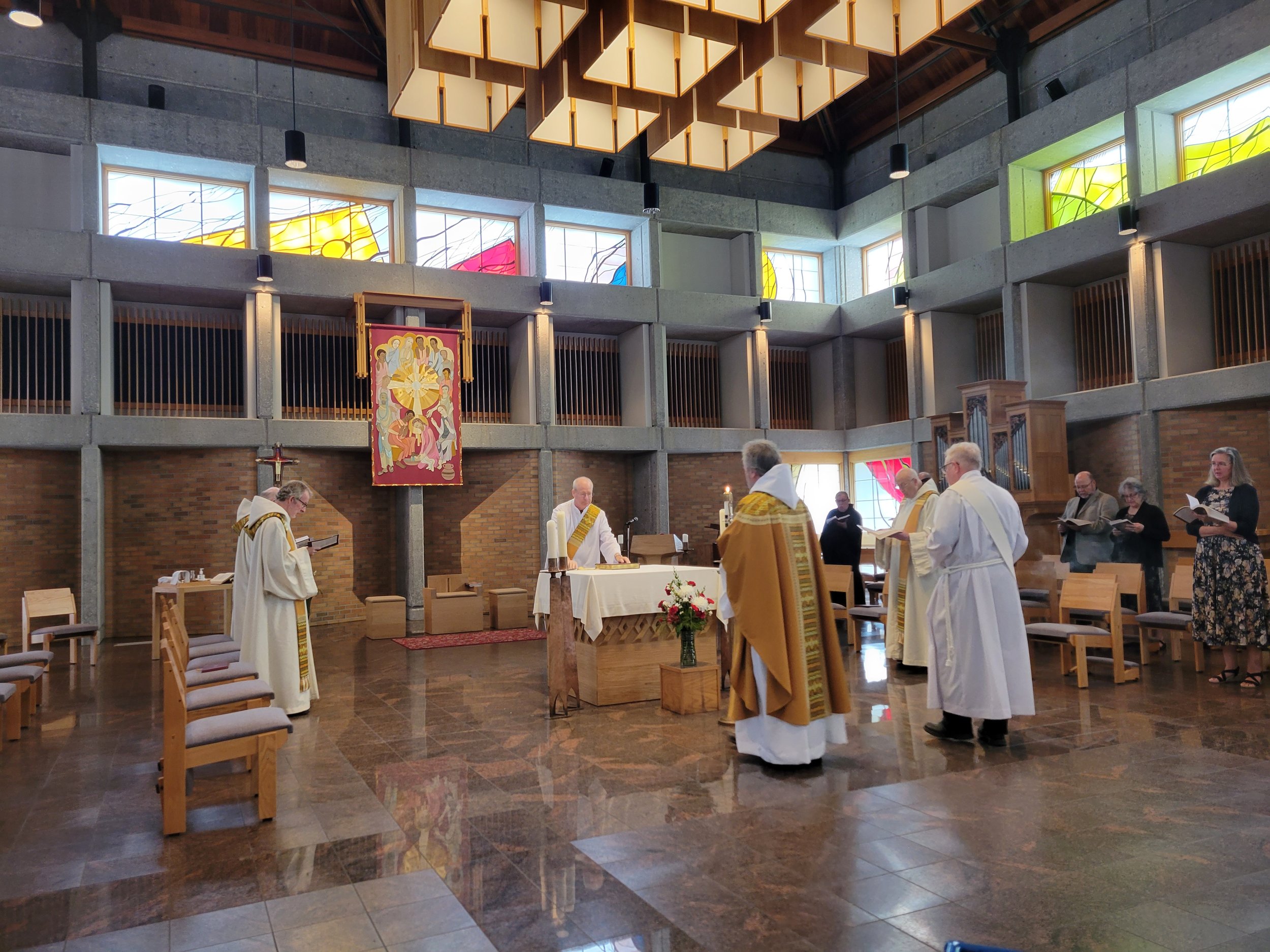
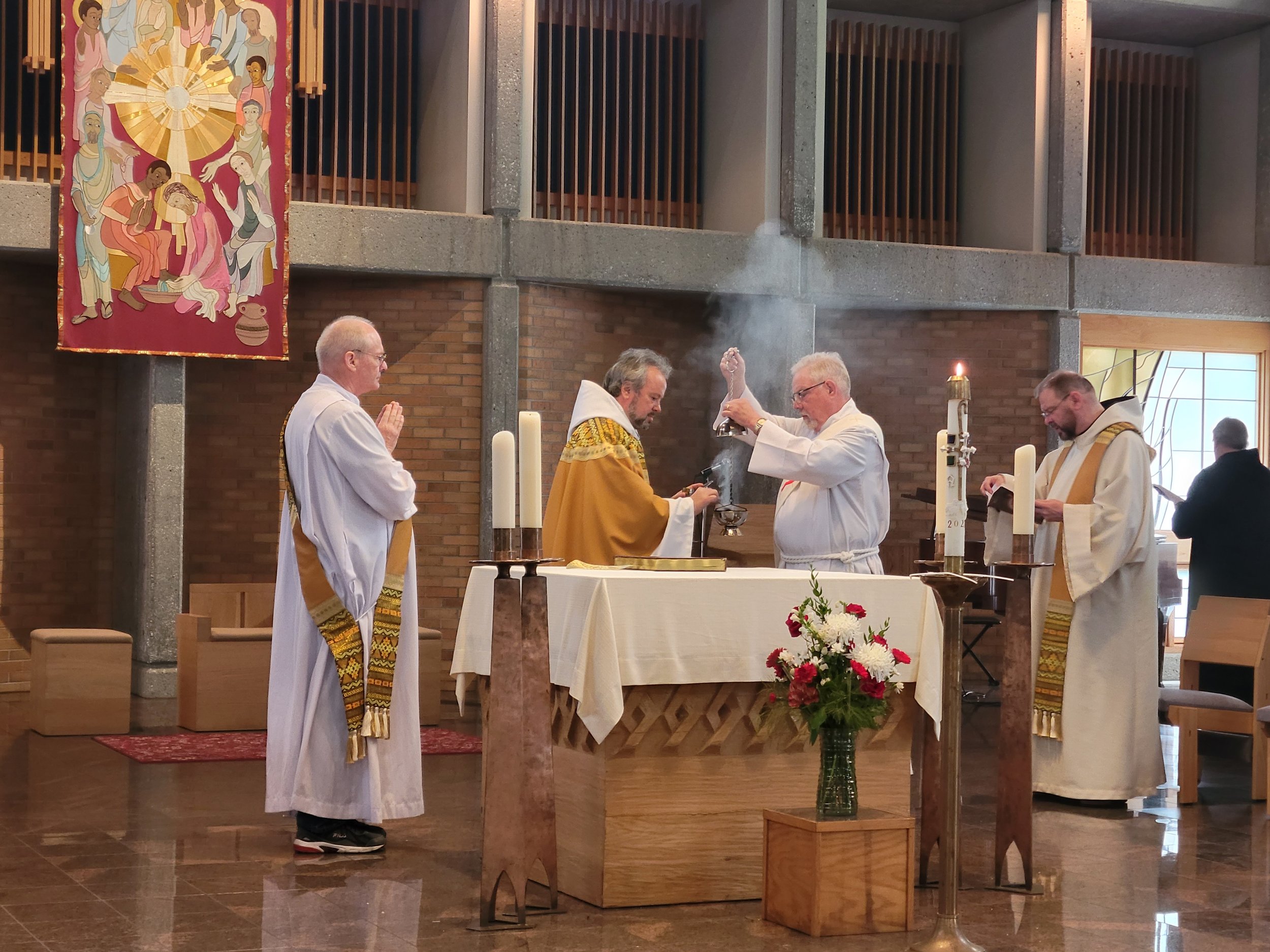
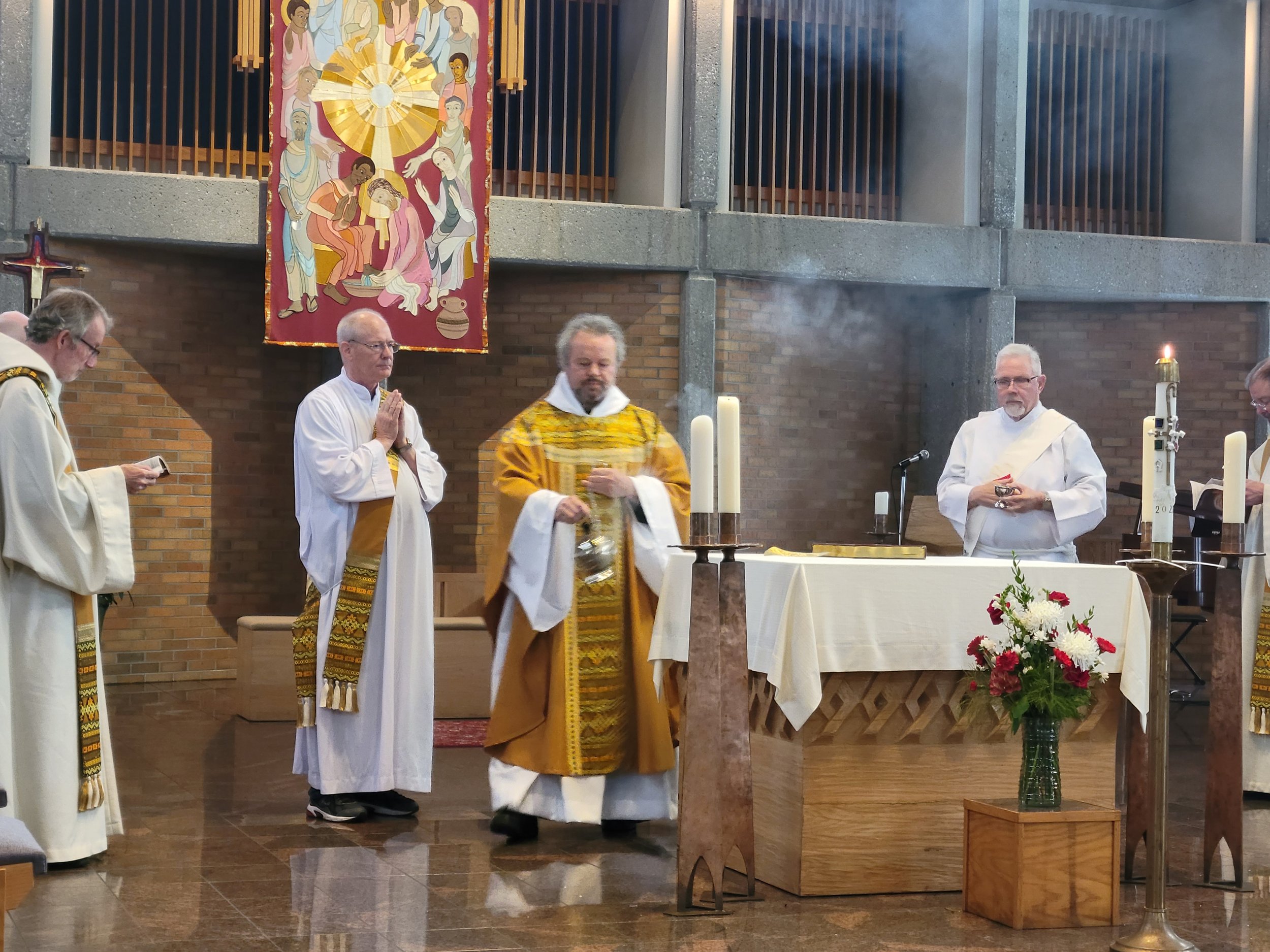
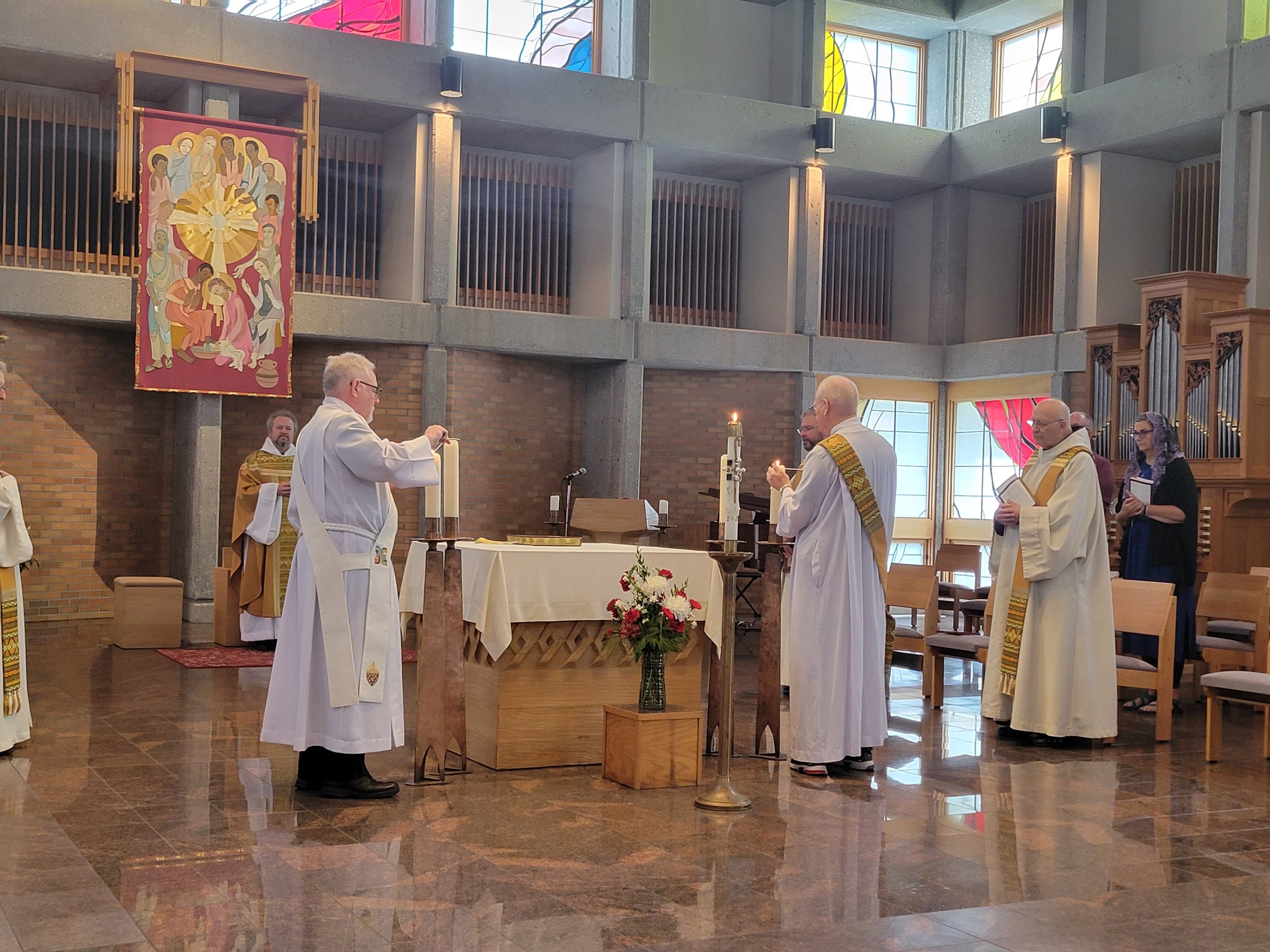
It is a beautiful feast church, the Feast of the Holy Trinity. We celebrate it in the after the great feasts of the Church, Pentecost, Ascension Day and Easter. Even the nature of early summer contributes to a good feeling. It is a grand conclusion to the Easter celebrations.
That is the reason why we put the Easter candle again in the midst of the chapel.
Those feasts that belong to the Son have now past. The feast, which is about the Holy Spirit, we celebrated last week.
And the Father is always included in those feasts. When Jesus was born: “He will be called the Son of the Most High”, or at the baptism in the Jordan when a voice from heaven says: "This is my beloved Son". The Father is the home that Jesus always mentions when he was talking about God .
Well, today all three together! It becomes clear that some people have their problems with this feast. If you have to explain how it is that three are one and one is three, then it is not so easy to say.
It is a statement of the creed that God is "One"! And that he is also “three persons”.
I would like to start with the word "Trinity":
Another word for "trinity" is the old word "threefold". It designates a shrine or, to put it more precisely, a chest of drawers with three drawers.
I still remember the chest of drawers that was in my grandparents' house. In the first drawer there were games for us children, in the second drawer there were books for the older ones and in the third drawer there were the sweets. Everything in one chest but in three drawers! For us children only ONE dresser!
And so God is said to be "Threefold." He is Father, Son and Holy Spirit.
Now let's open the drawers one by one.
The father: Visible in creation. Everything that has life got breath through him. He is the principle of life. We can't see him. Nobody can see him. But we can see his handwriting in everything that lives. And if we honor creation, if we care for and preserve it, we also praise its Creator.
The son: Jesus Christ lived among us as a human. God took flesh. A man in whom God was present at all.
God showed us in his son Jesus what a life for God could be like. Charity, healing the sick, he saves people from death, fellowship with all people no matter what class they come from.
And, that even in dying there is still hope, Jesus shows us through his death. For he rises from the dead – and life remains, not death.
The Holy Spirit: He takes away the fear of the disciples after Easter, puts the right words into Peter's mouth when he should speak, he brings the church together and turns a handful of frightened disciples into a flourishing church. It is God who gives us movement, who is our drive, who has a particularly strong effect in love. As Paul said in the second reading: “because the love of God has been poured out into our hearts through the Holy Spirit that has been given to us.”
And all three persons are one and the same God. He is God whom we can experience in our life.
And the Apostle John adds: (1 John 5:7-8) “Because there are three in Heaven that testify – the Father, the Word and the Holy Spirit – and these three are one.”
We have many examples here on earth where three things come together that can be used to explain the Trinity. But you won't really be able to explain it. We humans on earth remain limited with our possibilities.
What we can do is to stand before this God, to remain silent, and to try to answer through our lives. From the beginning of our Christian life we are drawn into this communion of the Trinity. At baptism we are baptized into the Trinity.
And what is interesting is that to give an answer is expected from us:
In the sacrament of baptism, the formula is:
“N., I baptize you in the name of the Father,
and of the Son,
and of the Holy Spirit.
There is no “Amen”
In the baptism of children this answer remains open. One would probably now expect an "Amen". But this "Amen" only comes at confirmation! Then the confirmand has to stand by his/her faith and say "yes" with his/her "Amen".
In the book of Revelation (5:13): Then I heard every creature in heaven and on earth and under the earth and in the sea, everything in the universe, cry out: “To the one who sits on the throne and to the Lamb be blessing and honor, glory and might, forever and ever.”
(Rev 5:14) “Amen,”
And later (Rev 19:4) “Amen, Alleluia”
Psalm 106:48: Blessed be the LORD, the God of Israel, from age to age! Let all the people say, Amen, Amen! Alleluia!
On Easter our song was the “Alleluja”. Our answer to God in our life is the “Amen”.
He is Jesus' father, he is also our father, Jesus is the son of God, we, too, are sons, are daughters, and both send us the Spirit so that we can live of his life and with his life and so that we, too, who are many, can become ONE as he is ONE.
AMEN.
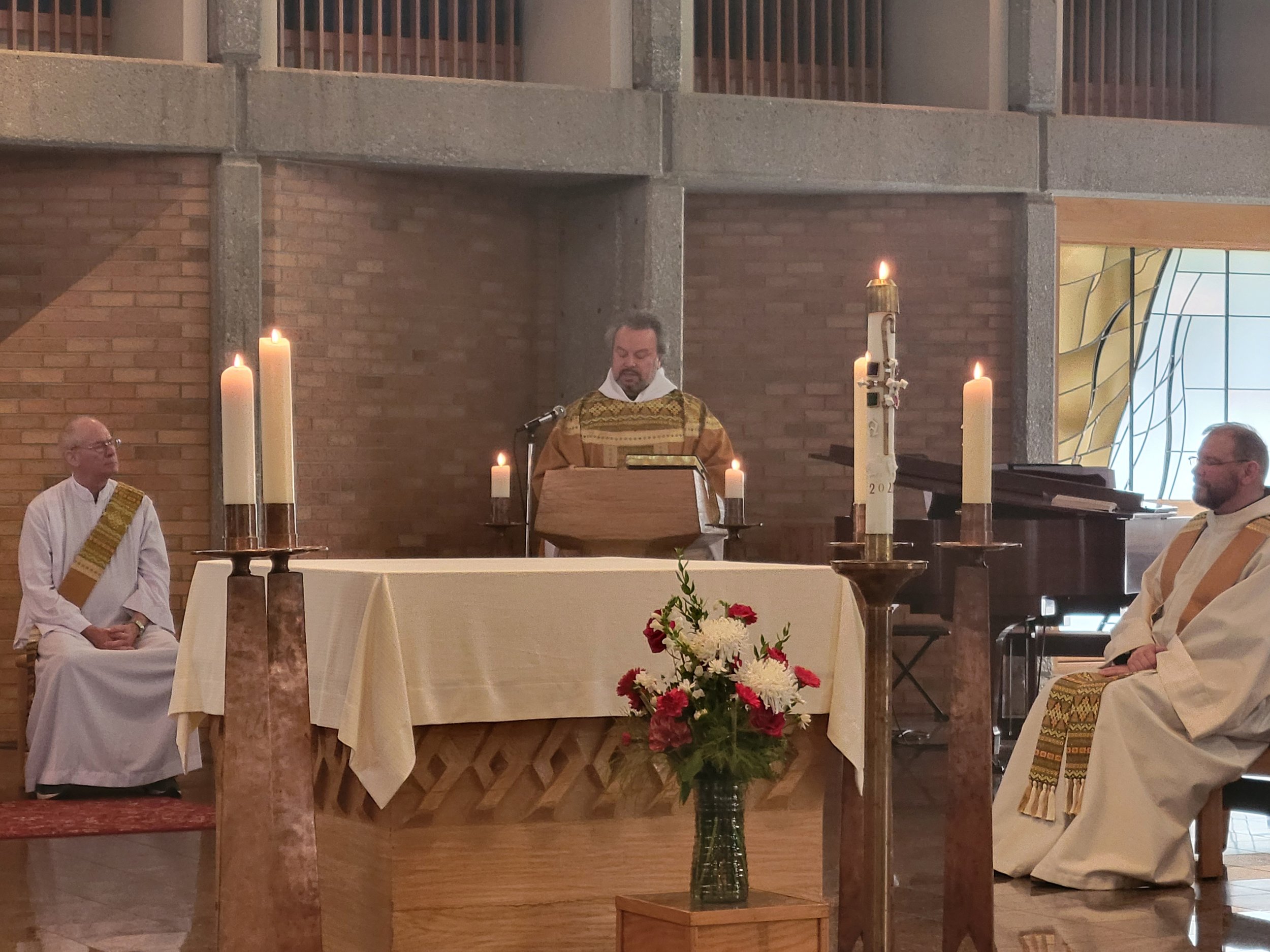
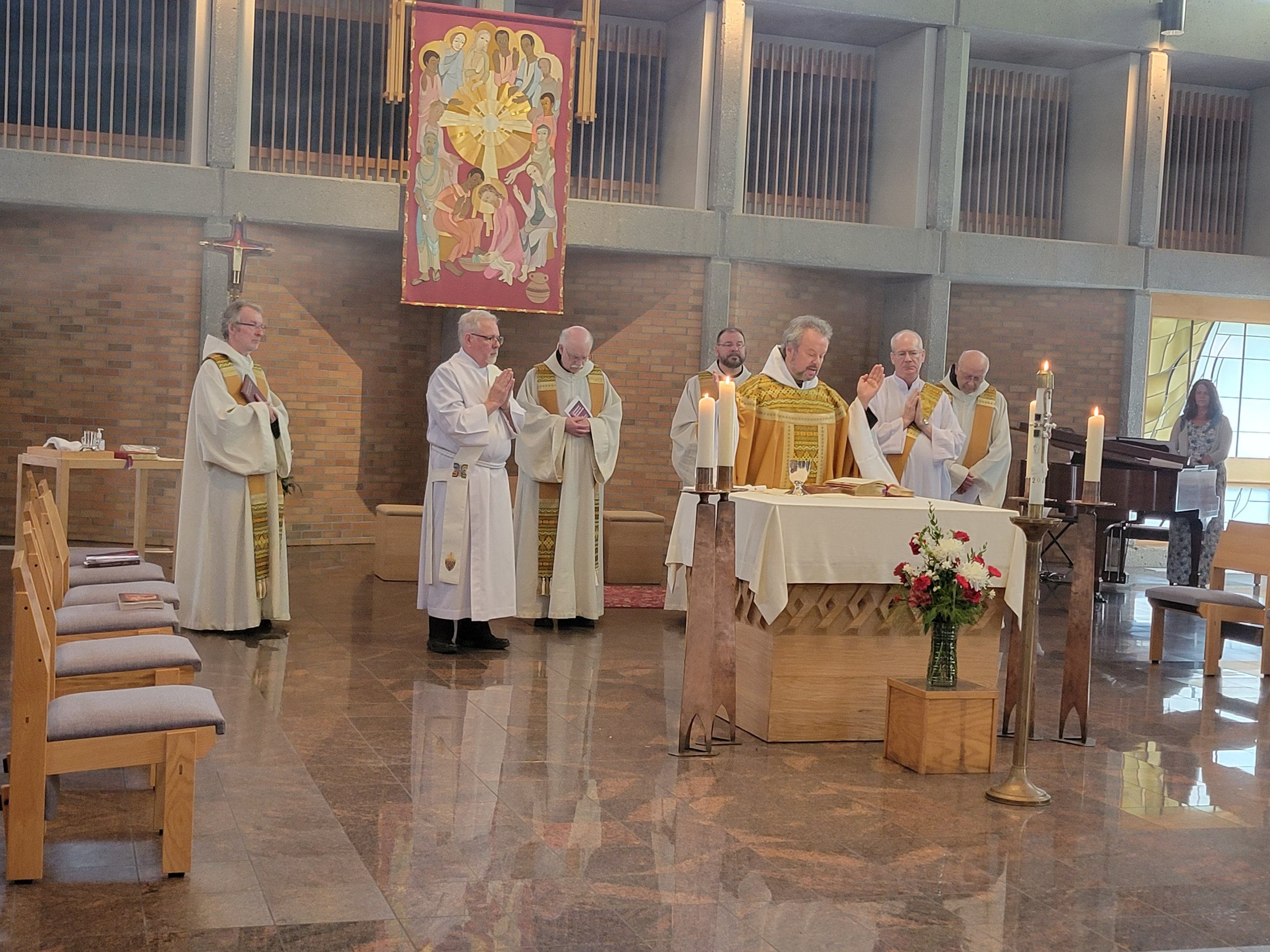
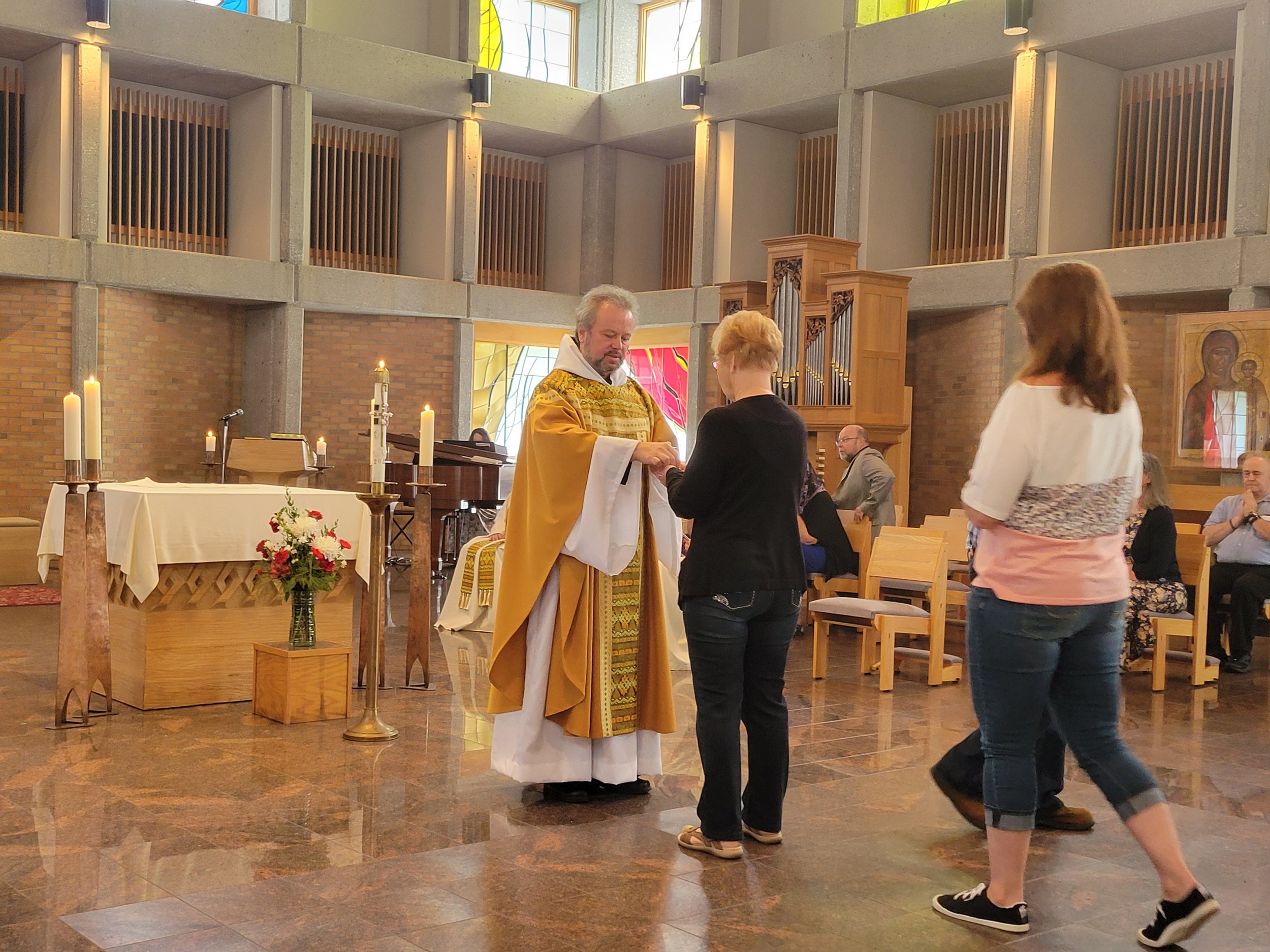
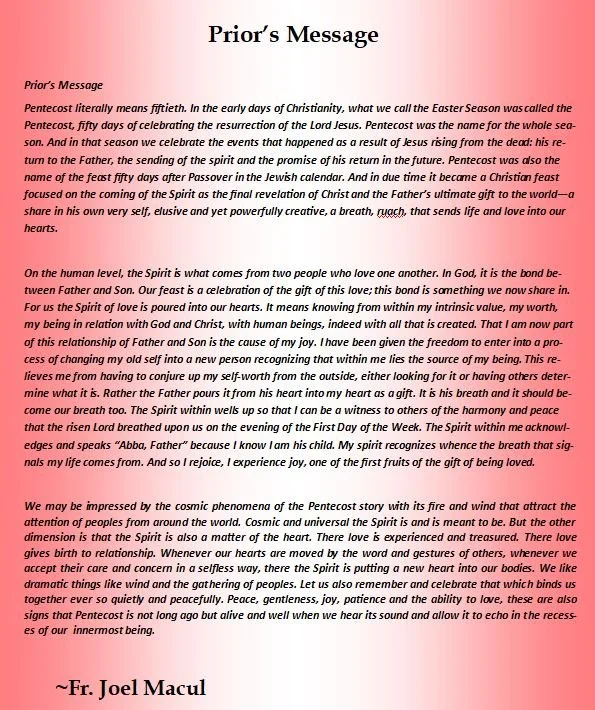
Prior's Message
Ascension of Our Lord
Fr. Adam Patras, OSB - celebrate
6th Sunday of Easter - 2022
Fr. Adam Patras, OSB - Celebrant
5th Sunday of Easter - 2022
Fr. Thomas Leitner, OSB - celebrant
Feast of St. Matthias - May 14th, 2022
Acts1:15–17, 23–26
John 15:9–17
There are a number of definitions of Church. Some of the more common ones are the Body of Christ, the People of God and the Christian community. You may have your own favorite definition or image that tries to capture who we are. But who would think right away that the Church is the friends of Jesus? And yet that how Jesus understands the group of disciples at the table with him. His relationship with them is a relationship that falls into the human category of friends. The customary relationship between a higher and a lower was master and servant or slave. But Jesus will not allow that structure from society to enter into the room. Instead, he speaks of his disciples as friends.
There are at least three signs of the friendship that Jesus extends to his disciples. One is that there are no secrets. How can this be? It is simply because Jesus’ experience of friendship is based on the relationship he has with the Father. Jesus tells us over and over again that he does not speak on his own, he speaks what the Father speaks. Jesus holds nothing back from us, his friends, either. He has shared everything with us. This ‘no secrets’ implies a certain knowledge and intimacy. If we are the friends of Jesus, it is not a casual relationship. It is grounded in openness, in listening and in passing on what we have come to hear him say in our day. It is not ourselves we talk about but always what he is saying.
At the heart of being friends with Jesus is that he lays down his life for his friends. This is more than a euphemism for his dying or the cross. It is the heart, the mission of Jesus. It is the depths of love and being loved. If the expression laying down his life for his friends is a euphemism for anything, it is love. It is the epitome of covenantal fidelity. Jesus surrounds his words today with the commandment to love one another. Put this in other words and it is the command to lay down your lives for one another. For that is what the love commandment entails.
We become a church, a community, to the extent that we accept Jesus as loving us. We might think we chose to love. Actually, when you think about it, human beings chose very little. But we bring our being loved to the situations that are not of our making. Our faith is based on responding to the experience of being loved. Jesus can call us his friends because we have accepted that he loves us. And in accepting that, we are accepting that his Father loves us. Jesus tells us his friends we did not choose him, he chose us. We are the object of his love. How can Jesus love us? Because, as he says, he knows he has been loved since before the foundation of the world. In other words, he has always been loved.
Jesus choosing us, Jesus loving us, is not because of what we do or say. It is really all gift. Our recognition that it is gift, that God in Jesus has set his face on us is that we take being loved and turn it into loving one another. Knowing and believing we are loved transforms us into people, a community, that lays down our lives for one another. And that is the third dimension of being chosen as the friends of Jesus. Our lives bear fruit, as Jesus, says in service. This service is our sacrificial love, this loving for love’s sake.
The Apostle Matthias we remember today is probably seen simply as a replacement to complete the number 12. But the story of the way he is chosen and Jesus speaking of our being chosen offers another perspective. It is clear in the prayer of the community that as much as they might cast lots, it is God who is choosing. The name Matthias means Gift of God, Gift of the Lord. Our being loved is above all a gift. It is in acknowledging the gift that we begin to become community, friends of Jesus, and bear fruit in a world that struggles in believing it is loved.
~Prior, Fr. Joel
4th Sunday of Easter - 2022
Prior, Fr. Joel Macul, OSB - celebrant
Acts 13:14, 43–52
Revelation 7:9, 14b–17
John 10:27–30
It is only three verses of Jesus that we are given on this Good Shepherd Sunday. These three verses place before us the image of Jesus as Shepherd. So does the reading from Revelation, which speaks of the Lamb Jesus shepherding the faithful and leading them to springs of life-giving water. The image of Jesus as the shepherd is one of the first, if not the first image of Jesus that is depicted in art of some kind. This representation of Jesus is seen even before the crucifix. The image of Jesus carrying the lost sheep on his shoulders may be found in the catacombs of Rome. There we also sometimes see a touch of green in the background to hint at the green pastures of Psalm 23. Surely it is meant to be an image of hope for the community as they lay their dead members to rest. Jesus carries us into the restored paradise, the newly opened garden.
Today Jesus draws our attention to one particular aspect of shepherding, namely the shepherd’s voice. This may strike those of us not familiar with the relationship between sheep and shepherd as a bit different from our usual consoling thoughts of a shepherd’s care. Recently I came across this scenario that might give an insight to the voice of the shepherd. In the state of Gujarat in western India, many shepherds gather their various flocks together at night in one place. This lets the shepherds share night watches and more easily protect the sheep. At daybreak, each shepherd calls his sheep to take them out for watering and then move on. The call of each shepherd is different. When the sheep hear it, they disentangle themselves from the flock and follow the voice of their own shepherd. Now, we should know that sometimes there are as many as 5000 sheep gathered together with the different shepherds. Each shepherd is so familiar with his own sheep and they with him that when the sheep answer his voice, the shepherd can recognize who is weak and who is straggling….It is clear that Jesus wants to put this relationship between shepherd and sheep mediated by the simple voice in front of us today.
The sound of the human voice calling out a name is both powerful and intimate. When we human beings call out to one another by name we are giving voice to a relationship that can send a message of hope and life. We are recognizing another for who they are; we acknowledge them. It is all a whisper of how we came into being in the first place. God spoke and said let us make man and woman in our image. And so it was. A word called us to life; a word called us forth from dust to be the crown of all that the word of God brought into being. Think of Mary Magdalene in the Easter Garden. She was disconsolate at the loss of Jesus and his very body. But Jesus speaks a most personal word to her, “Mary” and she responds right away with recognition, “My Teacher”. Then new life comes to Mary in this simple voice of Jesus. It does not take many words to say a name, to allow another person’s identity to come forward.
Today Jesus is talking about the community of his disciples. He speaks and they respond to his word. In that speaking, he is saying he knows them; there is a relationship between him and the community. It is not a knowing of information, of some detail or fact that he knows; it is a knowing of their hearts. And the community knows him in return. Like Mary Magdalene. We know who it is that is speaking to us. It is not a stranger. It is Jesus.
The relationship of shepherd and sheep that Jesus puts before us today is not about him and some ‘dumb sheep.’ No it is a relationship of reciprocity. Jesus knows the sheep, Jesus knows us and we in turn know him. This bond is as intimate as a husband and wife who have been faithful to one another for years. It has the steadfastness of friends that lasts for decades. Think of human bonds that are faithful in caring, in walking with you no matter what, that listen to one another for hours, that sit in silence and know the oneness between them. That says Jesus is what is happening between him and those who know his voice.
What are we doing at every Eucharist? We are here because we know his voice. We come here, we gather to hear it again and again. His voice feeds us. Yes, we need a sense of direction and we need his voice so as not to get lost, discouraged or burdened by guilt. The voice of the shepherd Jesus is not a shaming voice that beats us down, not a discouraging voice. Jesus’ voice is drawing us together from our various side trips, our solitary wandering and detours. We know Jesus’ voice and we need to hear him. His voice is essential for us. Today we hear many voices, in fact often a cacophony, all clambering for our attention. So we come here because the voice our Shepherd is trustworthy and grounds us. It keeps each of joined together lest we scatter or worse, lest we use words to divide us. Jesus is the familiar voice that summons us back to our common vision, our common hope for life and for the world. Jesus’ words call us back to the Kingdom of God, that network of relationships that binds us together as people of God, that being together where love never ends.
Jesus voice today assures us in strong language, that his relationship with us and ours with him will not allow us to fall out of his hand or the hand of God. They are holding on to us as perhaps we once did with a child or a younger sibling. We held on to a child lest they get lost, so they would not be afraid. And they trusted us. Once we say yes to the voice of our shepherd, his hand reaches out to us, we grasp it and from that moment on the Father and his Shepherd Son will not let us fall.
The power of the Word keeps calling out to us and so we gather; we and all whom the Shepherd led to the waters of baptism. And once gathered we acknowledge the one voice that reaches out to us. We are fed on that word. With the Shepherd’s voice sounding in our ears we can leave here to pasture awhile in this life. But we leave believing that there is always a hand that will not let us go but will be faithful to us until the Father reaches out to wipe away the last tear of this world’s suffering and pain.
The Shepherd is risen, alleluia.
~Prior, Fr. Joel Macul, OSB
Thursday of the 3rd Week of Easter
Prior, Fr. Joel Macul, OSB - celebrant
Acts 8:26–40
John 6:44–51
Sometimes we are told by concerned people not to pick up strangers and hitchhikers along the road. This could lead to trouble. It seems the Spirit today overrides such a concern for safety. Instead, the Spirit moves the deacon Philip to get out on the road, to be on the way and make himself visible to a traveler in a vehicle. And then, the Spirit moves the stranger, the eunuch from an exotic land, to invite the stranger running along the road into his chariot. And breaking all protocol of being cautious about the stranger actually asks him for advice about what he is reading.
What is Luke calling our attention to in this unique story about two people on the road? Remember that yesterday we read how deacon Philip went to proclaim the gospel in Samaria. It was welcomed and brought joy to the Samaritans. Today, deacon Philip is reaching out to a eunuch from a distant country. In both cases we are being told that the Spirit is working among the marginalized people of Israel. The Samaritans are sort of half-breed Jews; because their bodies were maimed eunuchs were not allowed to fully participate in the assembly or temple. Yet the Risen Jesus is restoring Israel, creating it anew, fulfilling its purpose. Those on the edges are being received into the community the Servant of God, Jesus, is calling together. Subtly the Spirit is bringing the words of the same prophet Isaiah that the eunuch is reading to fulfillment. For it is the prophet Isaiah that speaks of eunuchs having a place in worship in the restored Israel. It is Isaiah among others that speaks of people coming from Ethiopia to the New Jerusalem. And it is Isaiah who speaks of the suffering servant who brings all this about in his silence and humiliation. The eunuch is reading the prophet whose words become real in Jesus. The suffering and risen Jesus brings to reality what the prophet spoke and saw. The apparent stranger along the road helps the foreign visitor to Jerusalem to make the connection. Deacon Philip is doing with the eunuch what the Risen Lord once did for two downcast disciples walking on the road away from Jerusalem. He is breaking open the Scriptures so that the Servant and the Lamb are revealed.
Before Luke can reveal to us the Risen Lord’s call to the gentile world through the call of Paul and the experience of Peter and Cornelius in the next two chapters, he wants to bring into the community the fragments of scattered Israel. It is the Scriptures that are the key to this coming together. The result, we hear, is joy and rejoicing.
The response of the eunuch upon making the connection that Philip points out is simple: What prevents me from being baptized? What is preventing me from joining God’s suffering servant and rising with him out of the waters? Philip and the eunuch together go into the water for baptism.
We could ask ourselves when we see the connection between the Scriptures and who Jesus is and the potential for our lives, what holds us back from our dying to self so that we can truly live from the center of our being? What holds us back as individuals and community from accepting that the love that pulled Jesus out of death is still working to embrace myself and all God’s children, even those parts of myself that I have pushed back out sight over the years? Or am I afraid to let someone else, even a stranger, instruct me and help me read the Scriptures and my life?
Moments for letting go and allowing myself to be taught, to understand and to love again can appear anywhere along the road I am traveling. These moments are like the water the eunuch saw from his chariot and chose to plunge into with joy. These are moments when the Spirit is working. May we not be afraid of the guides who help us to find new meaning in our lives.
3rd Sunday of Easter - 2022
Fr. Thomas Hillenbrand, OSB - celebrant